Experience report
Monitor formation: developing attitudes inspired by Paulo Freire's principles / Formação de monitores: desenvolvimento de atitudes baseado nos saberes de Paulo Freire
Adriana Pedrosa1 (https://orcid.org/0000-0002-2316-1670)
Livia Souza Pugliese2 (https://orcid.org/0000-0002-1001-4241)
Cláudia Andrade Britto3 (https://orcid.org/0009-0009-2364-0127)
Enzo Thor Almeida dos Santos4 (https://orcid.org/0009-0003-4095-0975)
Ieda Maria Barbosa Aleluia5 (https://orcid.org/0000-0002-7979-1938)
1Corresponding contact. Escola Bahiana de Medicina e Saúde Pública (Salvador). Bahia, Brazil. [email protected]
2Universidade do Estado da Bahia (Salvador). Bahia, Brazil.
3-5Escola Bahiana de Medicina e Saúde Pública (Salvador). Bahia, Brazil.
ABSTRACT | INTRODUCTION: Academic monitoring in higher education contributes to the comprehensive development of both monitors and students. To achieve this, monitor training workshops must follow the principles of liberating and critical-reflective education, preparing the monitor beyond technical content-based approaches. OBJECTIVE: To report the experience of implementing a monitor training program, focusing on developing attitudes, knowledge, and skills essential for comprehensive training. EXPERIENCE REPORT: The attitude development workshop in monitor training begins with a reflection on the positive and negative aspects of the monitoring program, as well as possible solutions based on the monitors' experiences as students. After this stage, participants have 30 minutes to read excerpts from Paulo Freire's Pedagogia da Autonomia (Pedagogy of Autonomy), followed by a discussion circle to share their perceptions of the text and its correlation with the monitor’s educational practice. This approach integrates reflection and practice, promoting critical, collaborative, and participatory learning among future educators. FINAL CONSIDERATIONS: The workshop emphasizes a broad and critical reflection on the monitor’s role, encouraging problematization, analysis, and discussion of the competencies necessary for an active participant in the teaching-learning process. The aim is to prepare monitors who act as agents of transformation, rather than merely as content transmitters, contributing meaningfully to academic and human development.
KEYWORDS: Competency-Based Education. Medical Education. Undergraduate Medical Education. Educational Models.
INTRODUÇÃO: A monitoria acadêmica no ensino superior contribui para a formação integral tanto do monitor quanto do aluno. Para isso, as oficinas de formação dos monitores devem seguir os princípios da educação libertadora e crítico-reflexiva, preparando o monitor para além do tecnicismo conteudista. OBJETIVO: Relatar a experiência da implementação de um programa de formação para monitores, com foco no desenvolvimento de atitudes, conhecimentos e habilidades essenciais para sua formação integral. RELATO DE EXPERIÊNCIA: A oficina de desenvolvimento de atitudes na formação de monitores se inicia com a reflexão sobre os pontos positivos e negativos da monitoria, além de possíveis soluções, a partir da vivência dos monitores enquanto alunos. Após essa etapa, os participantes têm 30 minutos para ler trechos do livro Pedagogia da Autonomia, de Paulo Freire, e, em seguida, participam de uma roda de conversa para a discussão de suas percepções sobre o texto e sua correlação com a prática educativa do monitor. Essa abordagem busca integrar reflexão e prática na promoção de um aprendizado crítico, colaborativo e participativo entre futuros educadores. CONSIDERAÇÕES FINAIS: A oficina realizada foca na reflexão crítica e ampla sobre o papel do monitor, incentivando a problematização, a análise e a discussão sobre as competências necessárias a um sujeito do processo de ensino-aprendizagem. Assim, almeja-se formar um monitor que atue no componente curricular como agente de transformação do processo de ensino-aprendizagem, e não apenas como transmissor de conteúdo, contribuindo significativamente para o desenvolvimento acadêmico e humano.
PALAVRAS-CHAVE: Educação Baseada em Competências. Educação Médica. Educação de Graduação em Medicina. Modelos Educacionais.
How to cite this article: Pedrosa A, Pugliese LS, Britto CA, Santos ETA, Aleluia IMB. Monitor formation: developing attitudes inspired by Paulo Freire's principles. Inter J Educ Health. 2026;10:e6389. https://doi.org/10.17267/2594-7907ijeh.2026.e6389
Submitted July 24, 2025, Accepted Dec. 12, 2025, Published Mar. 16, 2026
Inter. J. Educ. Health, Salvador, 2026;10:e6389
https://doi.org/10.17267/2594-7907ijeh.2026.e6389
ISSN: 2594-7907
Assigned editor: Ana Cláudia Costa Carneiro
1. Introduction
The monitoring program in Brazilian universities was initially established by Law No. 5,540 of 1968, which sets standards for the organization and functioning of higher education. In the text, it is established that universities create monitor positions for students who take specific examinations, demonstrating mastery and the capacity to perform teaching activities in each discipline, and are remunerated for doing so¹. Law No. 9,394 of 1996 introduced changes to the previous legislation; however, the monitoring program retained a similar wording, allowing students to be integrated into teaching and research tasks, and to perform monitoring functions, according to their academic performance²,³. Since then, higher education institutions have implemented academic monitoring programs in accordance with specific internal legislation⁴.
Academic monitoring in higher education is a student activity, developed under faculty supervision, with the objective of promoting in these students the development of cognitive, procedural, and attitudinal competencies during formative processes and in the performance of activities as a monitor. In addition, the monitoring activity initiates the student-monitor into teaching and contributes to the teaching–learning process in the curricular component in which the monitor acts⁵,⁶. The central proposal of monitoring, therefore, is continuous peer learning, as students learn from their monitors; however, the monitors also learn from one another and from the students, in an exercise of ongoing knowledge exchange⁷. In this context, academic monitoring is an important opportunity in the education of the student-monitor⁸.
The monitor’s role should be broad, as it encompasses activities ranging from the planning of actions, followed by direct interaction with students, to the discussion of assessment processes with faculty members⁵. Thus, the monitor assists in the development of teaching materials, the implementation of active learning methodologies, the execution of practical activities, and the support with students’ questions, constituting an important link between faculty and students⁶,⁹,¹⁰.
In this way, monitoring activities go beyond the physical space and time of the classroom, as they include meetings, formative activities for future monitors, and extracurricular academic support for students⁹. Accordingly, some activities begin even before the start of the academic semester, such as the formative activities for future monitors. These formative activities aim to develop specific competencies related to the theoretical and practical foundations of the curricular component, as well as the skills and attitudes that underpin the exercise of the monitor’s role and their relationship with faculty, students, and society¹¹.
In this context, formative activities for monitors aim to reduce the difficulties faced by new monitors in the performance of their duties, to expand knowledge, and to standardize practices within the teaching–learning process²,¹². Moreover, formative activities should not be restricted to the acquisition of knowledge but instead should have a broad and reflective formative character.
Preparatory activities may involve discussions on the role of the monitor, reviews of techniques, deepening of knowledge, and improvements related to didactics². In addition, they should promote reflection on pedagogical praxis and on the role of the monitor as an educational agent.
Thus, the exercise of academic monitoring aims to construct knowledge inherent to practice; however, it is not limited to it. The formative and transformative context of education needs to be present and intentional in the preparation of monitors. In this sense, formative activities for monitors need to be aligned with the concept that education goes beyond training learners to perform their skills¹.
The formation of the monitor should be part of a critical-educational practice, guided by reflection on the teaching–learning process that goes beyond the transmission of technical-didactic content. In this way, the educational process is distanced from a banking model of depositing and acquiring knowledge¹³,¹⁴.
It is in this sense that, within a critical-educational practice, we must have coherence and clarity that it is not possible to aspire to a dialogical class, with student agency in which the student is the subject of their own teaching–learning process, when, in the process of monitor formation, we operate within a vertical teaching–learning model.
In this scenario, if, in the formative experience of a monitor, it is accepted that the formative agent—the subject—is the faculty member and that the one to whom knowledge is transferred—the object—is the monitor, the object today will be, tomorrow, a false subject in the process of “formation” of another future object: the student¹³. In this way, the fundamental role of the formative process is decontextualized, and coherence between what is said and what is done is lost.
The educational experience should be grounded in the inseparability between moral and ethical formation and the teaching–learning process of content inherent to the learner’s professional practice¹³. It is also not possible to be a subject of education while remaining detached from the world and from the people who directly or indirectly are part of and contribute to the entire teaching–learning process. Thus, it is not possible to separate the student, the citizen, and the future professional. Therefore, the comprehensive formation of the monitor is imperative, since educating means forming¹³.
Reflective formative activities on the teaching–learning process are fruitful in stimulating monitor/student’s curiosity rather than suppressing it¹⁵. It is in welcoming this curiosity that we demonstrate, through the embodiment of an example, that educational practice should be driven by critical thinking, based on respect for the student’s prior knowledge, experiences, and curiosities as part of a dialogical process¹⁴. The student’s experience, in this case the monitor, influences their practice as a student-monitor and inspires a possible future role as a faculty member¹³. In this process of constructing critical thinking, the monitor who aspires to become a faculty member or who, to a certain extent, plays an important role in the student’s teaching–learning process, should be encouraged to adopt a broader perspective and not one restricted to programmatic content, as they must reflect on the manner in which content is presented, whether dialogical or authoritarian¹³.
The book Pedagogia da Autonomia (Pedagogy of Autonomy), by Paulo Freire, guides the formative proposal presented in this report by recognizing the student as a historical and cultural subject, whose prior knowledge should be valued and problematized. Among the forms of knowledge necessary for teaching practice, Freire highlights respect for learners, dialogicity, awareness of incompleteness, and the understanding that teaching is not the transfer of knowledge, but the creation of possibilities for its critical-reflective construction¹³.
Within the context of academic monitoring, these principles support the view of the monitor as an educational agent who acts beyond disciplinary technicalism. Thus, the monitor’s formation should promote collaborative, reflective, and ethically committed practices, aligned with the assumptions of liberating education, which encourages student autonomy and protagonism. This perspective articulates attitudes, skills, and knowledge in a manner consistent with competency-based medical education.
Considering that academic monitoring also constitutes a space for initiation into teaching, it is essential that the formative process reflect these Freirean principles, fostering a critical, humanizing educational practice committed to social transformation.
The present report aims to outline one of the formative activities for new monitors of the Biomorphofunctional curricular component in a private medical school in Salvador, Bahia, focused on the comprehensive formation of the monitor, based on the competencies described in the article¹⁶.
2. Contextualization
The Histology monitoring program is part of the Biomorphofunctional curricular component of the Medicine course at a private, non-profit higher education institution located in Salvador, Bahia. The monitoring program comprises a total of 250 hours distributed over one year. Of this total workload, one hundred hours are dedicated to formative activities for new monitors, which are organized before the beginning of each academic semester and divided between them (fifty hours per semester for training). The monitoring program currently has eight monitors and four supervisors. After the selection process, the student enters the program as a monitor for first-semester students (M1) and subsequently becomes a monitor for second-semester students (M2). Thus, at the end of one year of monitoring, M2 monitors may apply for the position of supervisors.
The formative activities were organized according to what is presented in the article¹⁶, which lists the competencies considered necessary for the formation of the histology monitor and the systematization of activities to facilitate the monitor’s formative process. The systematization of these competencies is based on three axes: knowledge, skills, and attitudes, which aim at the comprehensive formation of the monitor. The formative activities employed active learning methodologies, with a focus on student/monitor protagonism, peer learning, and reflective discussion.
Formative activities are conducted over a one-week period in each semester of the monitoring program, addressing different aspects of monitor formation. The first activity is the formative activity focused on reflection on attitudinal competencies based on texts by Paulo Freire. On subsequent days, formative activities aimed at the development of knowledge and skills are conducted. These activities include the presentation and discussion of theoretical topics with faculty members, the presentation of histological slides, peer learning, and discussions on the use of technological resources. This report focuses on the first formative activity.
3. Experience report
3.1 Development of attitudinal competencies
The Histology monitoring program was implemented in 2013. Over more than a decade, since the first group of monitors, changes have been implemented regarding organization, methodology, and the schedule of activities, always grounded in the competencies described in the article by Pugliese¹⁶.
The development of attitudes consistent with the role of the monitor and with good coexistence in society is the focus of the first formative activity offered during the Histology monitor formation week. Although the development of these attitudes is the focus of the first formative activity, it is not limited to it, as during the other formative activities aimed at the construction of knowledge and skills, attitudes are addressed inseparably.
3.2 Organization of the formative activity
The initial part of the formative activity is devoted to reflection on the previous semester. Monitors and supervisors are invited to identify the positive and negative aspects of the challenges encountered and propose possible solutions. For this purpose, yellow, green, and pink pieces of paper are distributed, respectively. After the initial writing period, monitors are invited to exchange the papers and, when reading them aloud, debate the topic.
Reflection on pedagogical practice through listening and collective discussion is part of the monitor training process and is not intended solely for the improvement of the monitoring program. In this sense, monitors develop listening skills, learn to make space for silence, to motivate peers, and to engage in constructive discussion. In this process, which is democratic, they learn and teach how to disagree and agree in a humanistic and respectful manner, in accordance with the competency framework proposed in the article¹⁶. Revisiting and exchanging experiences from the previous semester also bring to light reflection on being an educator and on awareness of incompleteness, which will be further discussed in the second part of the formative activity.
In the second moment of the formative activity, monitors are given 30 minutes to read selected excerpts from a book authored by the educator and philosopher Paulo Freire. The themes addressed are described in Table 1.
Table 1. Themes from the book Pedagogy of Autonomy addressed in the formative activity
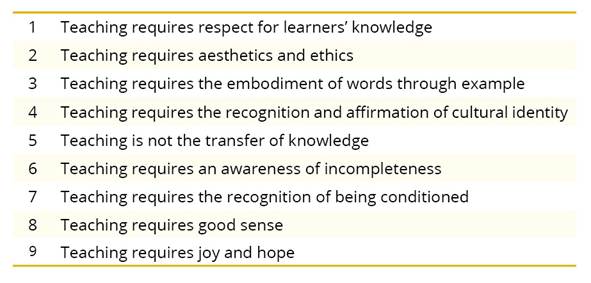
The criterion for selecting excerpts from Paulo Freire’s work, Pedagogy of Autonomy, was based on the attitudes intended to be addressed in the formation of the Histology monitor, as described in Pugliese¹⁶. Table 2 details these attitudes correlated with the respective themes of Pedagogy of Autonomy described in Table 1.
Table 2. Themes from the book Pedagogy of Autonomy addressed in the formative activity
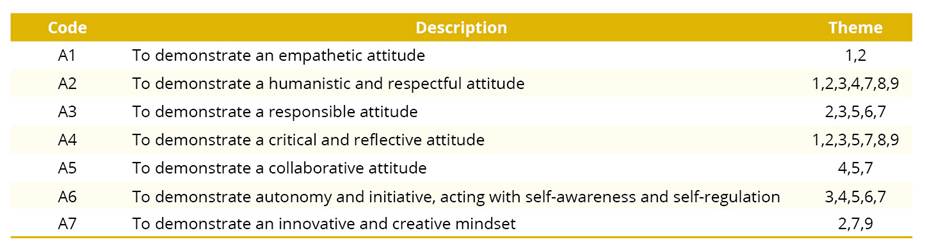
Code “A” in Table 2 corresponds to Attitude.
Once the allocated time has elapsed, a discussion circle is held regarding the text, aimed at collective reflection. Each monitor is responsible for commenting on one theme, reporting their perception of the text and the correlation between the text and the educational practice of being a monitor. At this stage, that lasts 90 minutes, guided by Paulo Freire’s teaching, monitors are invited to reflect on and problematize the educational process with the aim of transforming themselves and the world. Two of the authors of this article, who are currently supervisors, conducted the formative activities during the period when they were monitors. They now share their accounts of this experience.
This initial dynamic reaffirms the Freirean principle that critical reflection on practice and lived experiences is a condition for their transformation. By recognizing their own fragilities and potentialities, monitors experience awareness of incompleteness and understand that learning is a continuous and collective act. Active listening, respect for differences, and the exercise of argumentation are experienced not as content to be transmitted, but as dialogical practices that structure the formative activity itself.
3.3 Reflections of the supervisors
Supervisor 1
My experience as a monitor and supervisor, both in the classroom and in the formative activities, was a turning point in my academic trajectory, personal development, and future professional career. The focus of the formative activities goes beyond curricular content, addressing attitudinal issues, skills, and competencies that are fundamental for a student and a future physician. By studying and debating the ideas of Paulo Freire, we developed ethical principles, a posture of respect for diverse opinions, and this influenced my behavior in other academic activities. Competencies such as public speaking, improvisation, and empathy became fundamental for presentations in classes, at conferences, and in interactions with colleagues and students. Thus, it is evident that the skills and attitudes developed in the formative activities go beyond academic monitoring and will be essential in my future professional practice, whether in teaching or in other areas of life.
Supervisor 2
Academic monitoring, both in the classroom and in the formative activities, expanded my perspective beyond the curricular content of the curricular component. The first discussion among monitors and the supervising professor, based on excerpts from Paulo Freire’s texts, was a milestone in my life, helping me understand the responsibilities and core values of academic practice. I state that this experience had, and will continue to have, great value in my journey, as it served as a guide for my attitudes, speech, and thoughts. From my first day as a monitor through my role as a supervisor, I developed skills such as responsibility, commitment, time management, public speaking, dialogue, and respect. The balance between technical knowledge and attributes essential to the student was fundamental for my maturation and preparation for future challenges. Thus, my development was evident throughout this process, and I am confident that these competencies will be valuable in both a teaching career and the social and professional spheres.
The reports presented by the supervisors highlight the relevance of presenting and discussing, from the initial stages of training, the foundations of Paulo Freire’s liberating pedagogy. The experiences during the formative activities enabled them to understand teaching and the teaching–learning process as complex, continuous, reflective, and essentially dialogical practices. By articulating these forms of knowledge with the appreciation of students’ prior knowledge, the supervisors recognized that the monitor’s role involves ethical and human dimensions that go beyond technical mastery. Thus, Freirean pedagogy proves effective in constituting critical, sensitive, and socially committed subjects, both within and beyond the academic environment.
3.4 Final reflection
The systematization of formative activities for monitors aimed to promote the comprehensive formation of the monitor. The organization of the monitoring program was therefore based on competencies (knowledge, skills, and attitudes) consistent with being, knowing how to do, and knowing how to coexist, inherent to educational practice and teaching.
Over the years, we have added to and adapted the structure of the formative activities, incorporating new themes, texts, and methodologies to promote critical reflection, update topics, and welcome suggestions from monitors and supervisors.
In the training of monitors, we share Paulo Freire’s perspective, which states that:
“And let not be said that, if I am a biology teacher, I must not ‘go off into other considerations’ – that I must only teach biology, as if the phenomenon of life could be understood apart from its historical-social, cultural, and political framework”14.
In the case of the Histology curricular component, it can be inferred that the microscopic study of cells, tissues, and organs is not dissociated from the learner’s reality and from the world. There is no reason to yield to content-centered approaches, imposing a banking education in the formative process and, consequently, denying the monitor their creativity and protagonism. In this respect, we seek to stimulate and plant a seed in the monitor, emphasizing that there is an abysmal difference between teaching classes and being an educator. It is about planting the idea that education is the cornerstone of the world.
The practice of academic monitoring should be viewed as the performance of a broad function, not merely as the role of a teaching assistant. The monitor is a partner of the faculty member and plays an important role in the teaching–learning process, acting as an active agent both in their own development and as an educational agent and facilitator of the student’s teaching–learning process.
4. Conclusion
The university is a formative space. The activity of academic monitoring should follow this principle and broaden the monitor’s perspective in their understanding of the world, practice, and education. The construction and exchange of curious, dialogical, loving, and critical forms of knowledge benefits the monitor, faculty members, and students. Truly liberating education encourages the learner to develop a broad view of the pedagogical process and to become a critical, active, and transformative subject in society, rather than limiting themselves to being mere transmitters of content and knowledge. This is the form of liberating education we aspire to.
Authors’ contributions
The authors declared that they made substantial contributions to the work in conception or design of the research; the acquisition, analysis, or interpretation of data for the work; and the drafting or critical revision of relevant intellectual content. All authors approved the final version to be published and agreed to assume public responsibility for all aspects of the study.
Competing interests
No financial, legal, or political conflicts involving third parties (government, companies, private foundations, etc.) were declared in any aspect of the submitted work, including, but not limited to, grants and funding, participation on advisory boards, study design, manuscript preparation, statistical analysis, etc.
Indexers
The International Journal of Education and Health is indexed in DOAJ and EBSCO.
References
1. Presidência da República (Brazil). Lei nº 5.540, de 28 de novembro de 1968. Fixa normas de organização e funcionamento do ensino superior e sua articulação com a escola média, e dá outras providências. [Internet]. Diário Oficial da União. 1968. Available from: https://www.planalto.gov.br/ccivil_03/leis/l5540.htm
2. Ramos LAV, Costa DS, Cascaes JSA, Souza RTS, Rocha IFC, Galeno NS, et al. Plano de monitoria acadêmica na disciplina Anatomia Humana: relato de experiência. Ens Saude Ambient. 2012;5(3):94–101. https://doi.org/10.22409/resa2012.v5i3.a21015
3. Presidência da República (Brazil). Estabelece as diretrizes e bases da educação nacional. [Internet]. Diário Oficial da União. 1996. Available from: https://www.planalto.gov.br/ccivil_03/leis/l9394.htm
4. Dias AMI. A monitoria como elemento de iniciação à docência: ideias para uma reflexão. In: Santos MM, Lins NM, editors. A monitoria como espaço de iniciação à docência: possibilidades e trajetórias. Natal: EDUFRN; 2007. p. 37–44.
5. Nunes JBC. Monitoria acadêmica: espaço de formação. In: Santos MM, Lins NM, editors. A monitoria como espaço de iniciação à docência: possibilidades e trajetórias. Natal: EDUFRN; 2007. p. 45–57.
6. Natário EG, Santos AAA. Monitor program for university education. Estud Psicol (Campinas). 2010;27(3):355-64. https://doi.org/10.1590/S0103-166X2010000300007
7. Azevedo KLF, Azevedo Filho FM, Araújo KMFA. Peer instruction in higher health training: an integrative review. Rev Bras Educ Med. 2022;46(3):e20220088. https://doi.org/10.1590/1981-5271v46.3-20220088
8. Assis F, Borsatto AZ, Silva PDD, Peres PL, Rocha PR, Lopes GT. Programa de monitoria acadêmica: percepções de monitores e orientadores. R Enferm UERJ [Internet]. 2006;14(3):391–7. Available from: https://www.revenf.bvs.br/pdf/reuerj/v14n3/v14n3a10.pdf
9. Souza JPN, Oliveira S. Academic monitorship: teacher training for undergraduates. Rev Bras Educ Med. 2023;47(4):e20230189. https://doi.org/10.1590/1981-5271v47.4-2023-0189
10. Anjos FA, Cavalcanti EM. Relato de experiência sobre a monitoria acadêmica do componente Laboratório de Língua Inglesa em uma universidade brasileira. Babel Rev Líng Lit Estrangeiras. 2020;10(2):40-51. https://doi.org/10.69969/revistababel.v10i2.9361
11. Baricati CCA, Martins JT, Yagi MCN, Kreling MCGD, Karino ME, Volpato MP. Monitoria: metodologia ativa na prática do cuidar em um curso de enfermagem. Braz J Surg Clin Res [Internet]. 2017;21(1):76–9. Available from: https://www.mastereditora.com.br/periodico/20171204_190451.pdf
12. Fenili R, Barth JA, Crivellaro N, Belinaso L, Bohatch Júnior MS, Dietrich A. Monitoria em técnica cirúrgica e anestesiologia: utilidade do curso preparatório voltado para acadêmicos de medicina. Arq Catarin Med. 2015;44(3):101–8. https://doi.org/10.63845/a3tkqy12
13. Freire P. Pedagogia da autonomia: saberes necessários à prática educativa. 25ª ed. São Paulo: Paz e Terra; 1996. p. 1–76.
14. Freire P. Pedagogia da esperança: um reencontro com a Pedagogia do oprimido. São Paulo: Paz e Terra; 1992. 336 p.
15. Sindique C. O uso das metodologias activas de aprendizagem para a promoção de autonomia no estudante: uma análise a partir de Paulo Freire. Tec Soc Con. 2021;8(2):e0240048–68. https://doi.org/10.20396/tsc.v8i2.15884
16. Pugliese LS, Moura AP. Competency-based education as a framework for the systematization of academic monitors instruction. Rev Inter Educ Saúde. 2024;8:e5443. https://doi.org/10.17267/2594-7907ijeh.2024.e5443
