Education, comprehensiveness, and healthcare in primary care
Influence of sleep quality on academic performance of Biological Sciences students / Influência da qualidade do sono no desempenho acadêmico de estudantes de Ciências Biológicas
Anna Brycia Brito Testi1 (https://orcid.org/0009-0005-6434-7745)
Maria Cecilia Picinato2 (https://orcid.org/0000-0002-3646-7839)
1Corresponding contact. Universidade Federal do Oeste da Bahia (Barreiras). Bahia, Brazil.
2Universidade Federal do Oeste da Bahia (Barreiras). Bahia, Brazil. [email protected]
ABSTRACT | INTRODUCTION: Sleep plays a fundamental role in an individual's ability to assimilate and consolidate learning. Sleep quality is closely linked to the learning process, and its lack can lead to unsatisfactory academic performance as well as compromise the student's quality of life. OBJECTIVE: This research aimed to evaluate sleep quality, excessive daytime sleepiness, and their potential impact on the academic performance of university students in the Biological Sciences course, in both bachelor's and teaching degree modalities. METHODS: The Pittsburgh Sleep Quality Index (PSQI) was used to assess students' sleep quality, and the Epworth Sleepiness Scale (ESS) was applied to analyze daytime sleepiness. Academic performance was evaluated using three questions regarding students' perception of their own academic achievement. The study included 76 biology students from the Universidade Federal do Oeste da Bahia (Federal University of Western Bahia), Barreiras-BA campus. RESULTS: More than half of the participants reported severe difficulties falling asleep, and daytime sleepiness with a PSQI median of 9.18 points and 9.3 points for ESS. Age-stratified analysis showed significant differences, indicating improved sleep quality and reduced sleepiness with advancing age (p<0.05). Students with poor sleep quality had 6 times higher chances of poor academic performance (p=0.6569) compared to colleagues who sleep well. CONCLUSION: Academic performance is statistically associated with poor sleep quality. Implementation of interventions aimed at reducing stress and promoting sleep hygiene is recommended, including the adoption of regular sleep and study schedules to improve both academic performance and overall student well-being.
KEYWORDS: Sleep Quality. Daytime Sleepiness. Biological Sciences. Academic Performance.
RESUMO | INTRODUÇÃO: O sono desempenha um papel fundamental na capacidade do indivíduo de assimilar e consolidar o aprendizado. A qualidade do sono está intimamente ligada ao processo de aprendizagem, e a falta dela pode levar a um desempenho acadêmico insatisfatório, além de comprometer a qualidade de vida do estudante. OBJETIVO: Essa pesquisa teve como finalidade avaliar a qualidade do sono e a sonolência diurna excessiva e o possível impacto no desempenho acadêmico de universitários do curso de Ciências Biológicas, nas duas modalidades, licenciatura e bacharelado. MÉTODOS: Para a avaliação da qualidade do sono dos discentes foi utilizado o Pittsburgh Sleep Quality Index (PSQI) e a Epworth Sleepiness Scale (ESS), para analisar a sonolência diurna e para avaliar o desempenho acadêmico dos discentes foram utilizadas três perguntas acerca da percepção do aluno em relação ao seu próprio rendimento acadêmico. Participaram da pesquisa 76 universitários dos cursos de Ciências Biológicas da Universidade Federal do Oeste da Bahia, campus Barreiras-BA. RESULTADOS: Mais da metade dos participantes relataram dificuldades severas para dormir e sonolência diurna, com mediana do PSQI de 9,18 pontos e 9,3 pontos para ESS. A análise por faixa etária mostrou diferença significativa, indicando melhora da qualidade do sono e redução da sonolência com o avanço da idade (p<0,05). Os discentes que apresentaram má qualidade de sono têm 6 vezes mais chances de apresentar um rendimento ruim nos estudos (p=0,6569), em comparação aos colegas que dormem bem. CONCLUSÃO: Constata-se que o desempenho acadêmico está estatisticamente associado à má qualidade do sono. Recomenda-se a implementação de intervenções destinadas à redução do estresse e à promoção da higiene do sono, incluindo a adoção de horários regulares para sono e estudo, a fim de melhorar tanto o rendimento acadêmico quanto o bem-estar geral dos estudantes.
PALAVRAS-CHAVE: Qualidade do Sono. Sonolência Diurna. Ciências Biológicas. Desempenho Acadêmico.
How to cite this article: Testi ABB, Picinato MC. Influence of sleep quality on academic performance of Biological Sciences students. Int J Educ Health. 2026;10:e6585. https://doi.org/10.17267/2594-7907ijeh.2026.e6585
Submitted Nov. 17, 2025, Accepted Feb. 3, 2026, Published Mar. 31, 2026
Int. J. Educ. Health., Salvador, 2026;10:e6585
https://doi.org/10.17267/2594-7907ijeh.2026.e6585
ISSN: 2594-7907
Assigned editors: Iêda Andrade, Ana Cláudia Costa Carneiro
1. Introduction
Sleep disorders and deprivation represent alarming consequences that interfere with individuals' personal lives. According to the International Classification of Sleep Disorders (ICSD-3), over 80 sleep disorders are described, which, when correctly diagnosed, can be managed; the most common include insomnia, sleep apnea, restless legs syndrome, and narcolepsy1. These sleep disorders can occur at any stage of life and exhibit determined associations with age groups, biological maturity, and sex2,3. Studies suggest that the prevalence of these disorders is linked to cerebral biochemical dysregulation and a turbulent external environment, with sleep disorders predominating in individuals with psychiatric conditions such as schizophrenia, Alzheimer's disease, and bipolar disorder, as well as in healthy individuals experiencing extreme sleep deprivation, as observed in episodes of mania, hallucinations, and paranoia4-6.
In specific populations, such as university students, insomnia impairs neurocognitive functions, academic performance, and circadian synchrony, thereby affecting curricular progress7. Paradoxically, compensatory extension of wakefulness to offset prior deprivation perpetuates poor sleep quality, characterized by prolonged sleep latency and deficits in restorative sleep, resulting in progressive deterioration of sleep health throughout the undergraduate program8-11. Regarding this vulnerability, university students are more prone to poor sleep quality than the general school community, as these individuals adopt new habits to accommodate coursework activities, extracurricular commitments, work, leisure, and social interactions12.
Although more scientific data focuses on health sciences students, particularly in Medicine and Nursing—due to their distinct full-time academic trajectories—programs such as Biological Sciences exhibit accentuated rates of poor sleep quality. This is attributed to full disciplinary workloads with nighttime schedules, irregular study patterns, commuting difficulties to the university, socioeconomic profiles, technology use before bedtime, and atypical teaching shifts for licensed educators11,13-15.
2. Methodology
This was a quantitative, observational, cross-sectional, and descriptive study. Data were collected through two self-administered online questionnaires hosted on Google Forms, targeting students enrolled in the Biological Sciences program at Universidade Federal do Oeste da Bahia – UFOB (Federal University of Western Bahia). The first instrument was the Pittsburgh Sleep Quality Index (PSQI), which assessed sleep quality, and the second was the Epworth Sleepiness Scale (ESS), which evaluated daytime sleepiness. General subjective questions were included to examine correlations between sleep quality and self-reported academic performance. After providing study information and obtaining informed consent via the Free and Informed Consent Form (TCLE), participants completed the questionnaires. The study was approved by the Comitê Nacional de Ética e Pesquisa – CONEP (National Research Ethics Committee) under Brazilian Ruling 466/12, with protocol CAAE No 71149123.4.0000.8060.
The study population comprised 76 students of both sexes, aged 18 years or older, regularly enrolled in the Biological Sciences program at UFOB. Data analysis was performed using the Statistical Package for the Social Sciences (SPSS) software, latest version for Windows. Differences between sleep quality and daytime sleepiness categories were analyzed using the Student's t-test. Associations between sleep quality and other variables (sex, academic cycle, daytime sleepiness, and academic performance) were assessed via odds ratio (OR) calculations. Multinomial logistic regression models were applied to further validate the relationship between sleep quality and students' academic performance. Finally, Pearson's correlation coefficient was calculated to evaluate associations among daytime sleepiness levels, sleep quality, and participants' perceptions of academic performance. A significance level of p<0.05 was adopted for all statistical tests.
3. Results
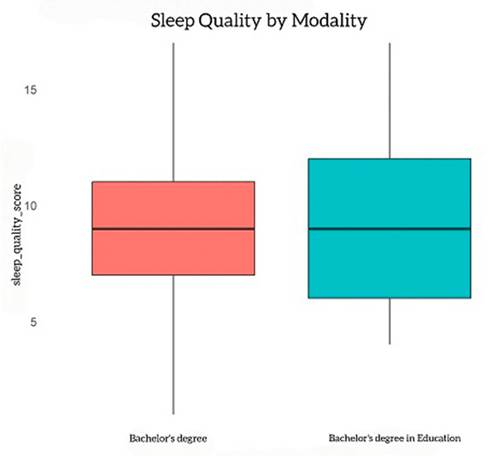
From the data collected via the electronic questionnaire from participating students, a prevalence of 76.3% (n=58) female students, 22.4% (n=17) male students, and others who chose not to disclose was observed. Regarding age distribution, ages ranged from 18 years (youngest) to 32 years (oldest), with a predominance in the 20–24 years age group. PSQI score analysis revealed a median of 9.18, exceeding the clinical cutoff (>5) and indicating a concerning prevalence of sleep disturbances among participants (Figure 1).
Figure 1. Sleep quality of undergraduate Biology students (Bachelor's and Teaching modalities) at UFOB, research participants, derived from Pittsburgh Sleep Quality Index (PSQI) scores
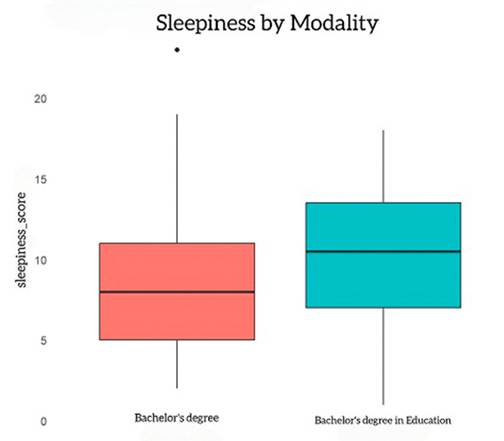
Regarding daytime sleepiness (ESS) distribution among students, with scores ranging from 1 to 23, the mean was 9.329, revealing considerable sleepiness levels that may impair attention, memory, and academic performance. However, sleepiness levels were significantly higher among Teaching modality students (10.7 vs. 8.5; p=0.046) (Figure 2).
Figure 2. Daytime Sleepiness Index of undergraduate Biology students (Bachelor's and Teaching modalities) at UFOB, research participants, derived from Epworth Sleepiness Scale (ESS) scores
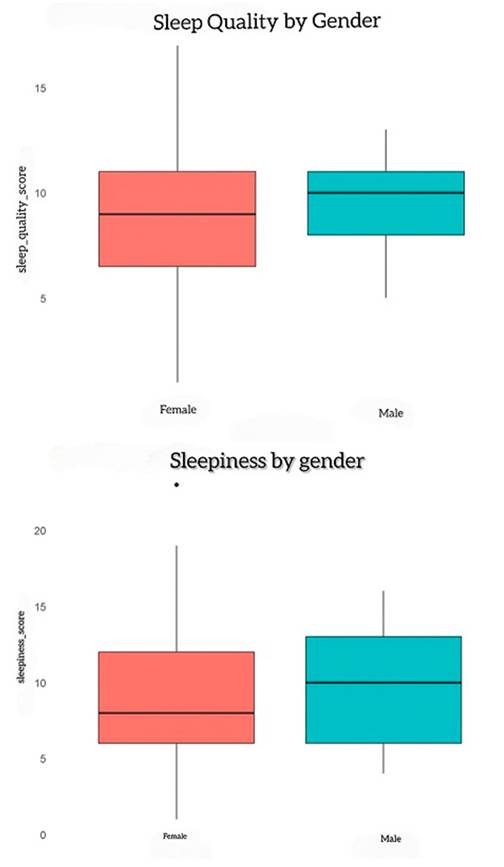
With respect to gender (female vs. male), no significant differences were found in sleep quality (p=0.6312) or sleepiness (p=0.55) above the significance level (p>0.05) (Figure 3).
Figure 3. Sleep quality and daytime sleepiness by student gender
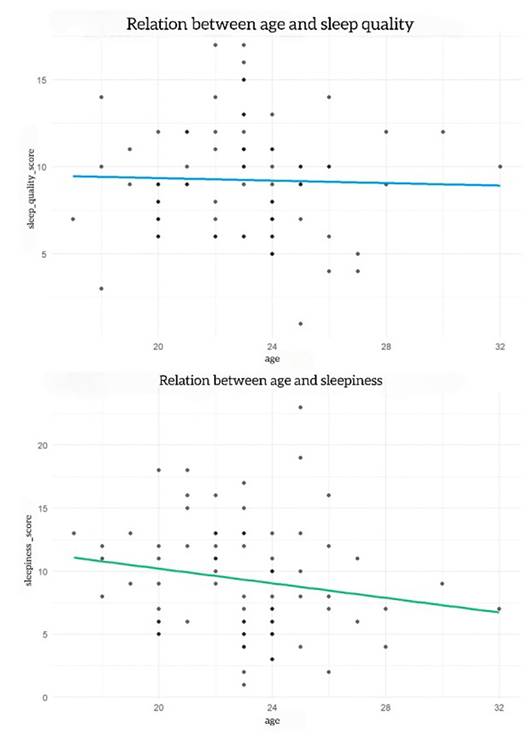
Age group analysis via ANOVA revealed significant variance in sleep quality across age groups (p=0.00115), below the adopted significance level (p<0.05), indicating improved sleep quality and reduced sleepiness with advancing age. However, linear correlation analysis between continuous numerical age (each year individually) and sleep quality was not significant (p=0.8019 > 0.05).
Figure 4. Sleep quality and daytime sleepiness by age group of participating students
Multiple Correspondence Analysis (MCA) yielded relevant results on the association between academic difficulties and poor sleep quality (Figure 5). The MCA plot, derived from keywords in each quadrant—"poor sleep quality," "yes," "academic difficulties," "female," "+24," "Bachelor's"—as well as corresponding terms for "Teaching," age "21–23," and "male" for category comparison (age, modality, gender), explained 42.6% of total variance, demonstrating strong association. Age proved a determining factor in both sleep duration and academic performance, influenced by semester, with students aged 24+ showing less academic difficulty compared to those under 21.
Figure 5. Multiple Correspondence Analysis (MCA) of the association between academic difficulties and poor sleep quality
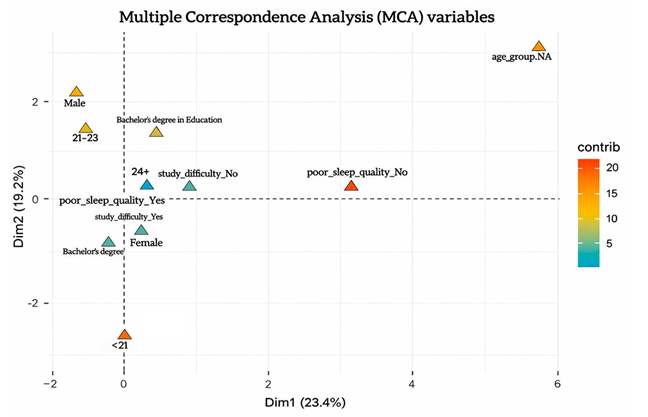
Results indicate that gender, course modality, and academic performance relate to sleep quality and student outcomes. Bachelor's students exhibited greater academic difficulties associated with poor sleep quality, whereas Teaching students had poor sleep quality but lesser academic impact. Multinomial logistic regression showed an association between good sleep quality (PSQI ≤5) and absence of academic difficulties, with an odds ratio (OR) of approximately 1.5 (p=0.4055 > 0.05). This suggests students with good sleep have about 1.5 times lower odds of reporting academic difficulties compared to those with poor sleep. Biology students with poor sleep quality had 1.8 times higher odds of academic difficulties (OR=1.8075) with a trend toward significance (p=0.0695) compared to those with good sleep. Additionally, students with poor sleep had six times higher odds of low academic performance relative to those with adequate sleep, though not statistically significant (p=0.6569).
4. Discussion
The present study revealed an extremely high prevalence of poor sleep quality and daytime sleepiness among undergraduate Biology students, with over half of participants reporting sleep difficulties, frequent daytime sleepiness, and negative academic impact (PSQI median=9.18; ESS mean=9.3). The literature reports PSQI global scores of 6.4–8.75 among university students aged 19.82–24.16 years16.
A multicenter medical student study by Miguel et al.17, using PSQI, found a mean global score of 6.72 ± 3.02. Araújo and Almondes18 reported high daytime sleepiness (ESS mean=9.38 ± 4.03) among undergraduates. Our findings suggest significantly elevated poor sleep quality and excessive daytime sleepiness among Biology undergraduates, confirming prior studies on this population's vulnerability to sleep disturbances. This underscores the need for ongoing sleep health research, given its potential impact on quality of life and academic performance.
An American College Health Association (ACHA)–National College Health Assessment (NCHA) study in Maryland, USA (2000–2023; mean n=1,597,993 university students) showed significant sleep quality decline, with mean days per week of sufficient sleep dropping from 3.07 (2000) to 2.42 (2023)19. The proportion reporting sufficient sleep ≤2 days/week rose from 39.5% to 59.8%, disproportionately affecting women, Black, Indigenous, Asian, Latino, Arab, and other non-White students19.
Regarding gender, no significant differences were found in sleep quality (p=0.6312) or daytime sleepiness (p=0.55; p>0.05).
The findings of this study corroborate the results presented by Medeiros et al.20, who also did not identify statistically significant differences between the two variables analyzed (p=0.5079). This convergence can be attributed to the fact that the students are part of a homogeneous academic environment, subject to similar demands and pressures, which tends to standardize the behavioral and academic responses observed. However, some studies consistently point out that women have poorer sleep quality and a higher prevalence of sleep disorders compared to men, regardless of age group or context analyzed, even though gender distributions between studies generate inconsistencies in results11,16. In contrast, contrary to the above findings and those of this study, in a study conducted in India with medical students at the Pravara Institute of Medical Sciences, women had better sleep than men21.
In the comparison by age group, in our study, the analysis of variance (ANOVA) showed a significant difference between the groups (p=0.00115). It was observed that as age increases, there is a tendency for sleep quality to improve in relation to the reduction of daytime sleepiness. A study conducted by Liu et al.22 in Hubei Province, China, involving university students, comparing the sleep quality of students from elementary school to university, showed that sleep quality tends to worsen until high school as the level of education increases, reaching the highest level in high school (41.9%) and in vocational high school (28.6%); however, it decreased at the university level (28.5%), where academic pressure is supposedly relatively lower. It is worth noting that this percentage found in university students occurred simultaneously with the use of sleep-inducing medications (6.4%). Possibly, this reduction in the prevalence of poor sleep quality in the university phase indicates a trend toward improved sleep with age and academic advancement, probably associated with lower academic pressure or greater adaptation to lifestyle. However, in our study, the analysis between continuous variables (age and sleep) did not show a significant linear correlation (p=0.8019) greater than the level of significance (p>0.05), suggesting a nonlinear relationship, indicating that it is not correct to expect a pattern of continuous and uniform improvement over the years, but rather specific variations by age group. It should be noted that the improvement in sleep quality and reduction in sleepiness with advancing age require caution due to the small sample size and generation. Future studies with larger samples and longitudinal designs are needed to validate whether the observed trends reflect real differences between cohorts or generational influences.
Another result of the study conducted by Giri et al.21 with medical students at the Pravara Institute of Medical Sciences, Western Maharashtra, India, showed that sleep disorders are common among medical students and residents and are related to age, gender, living conditions, exercise, coffee consumption, alcohol, tobacco, stress, and use of electronic devices. In addition, another factor that impacts sleep quality and daytime sleepiness is related to the period of the course; some studies show a significant worsening in the early years and gradual improvement in later stages23,24.
Regarding academic performance, Multiple Correspondence Analysis (MCA) revealed that its two main dimensional axes represent 42.6% of the total variance in the data, highlighting associative patterns between sleep quality, self-perception of academic difficulties, gender, course modality, and age group. This result indicates that almost half of the variations in the performance of Biological Sciences students can be attributed to sleep disorders, reinforcing the central hypothesis of the study and highlighting sleep as a critical factor in university learning.
These findings corroborate the results of the systematic review by Garcia et al.16, which found that sleep quality, often assessed by the Pittsburgh Sleep Quality Index (PSQI), and academic performance were negatively correlated. It is noteworthy that age is a determining factor, with students ≥ 24 years old presenting less academic difficulty, while younger students (< 21 years old) show a higher prevalence of poor sleep and a greater negative impact on performance. Gender and course modality had less influence, indicating that the relationship between sleep and academic performance is transversal. The study conducted with students at the Centro Universitário de Brasília - UniCEUB (University Center of Brasília) showed that 54.07% (n=166) of students had poor sleep quality, while 36.80% (n=113) reported sleep disorders14.
The perception of most students indicated that this condition negatively impacts their academic performance, significantly compromising their performance and achievement in Nutrition, Psychology, and Biological Sciences courses. For validation purposes in our research, the analysis performed using logistic regression involving the association between good sleep quality and academic performance showed a p-value of 0.4055, indicating no statistically significant association (p>0.05). This result corresponds to an odds ratio of approximately 1.5, indicating a 1.5 times greater probability of not presenting impaired sleep and concomitant academic difficulties. However, this association lacked statistical significance at the conventional level adopted (p<0.05), suggesting the absence of robust evidence for a clinically relevant relationship between these variables in the present sample set. Meanwhile, students enrolled in biological sciences courses are 1.8 times more likely to experience academic difficulties associated with poor sleep quality (odds ratio=1.8075). This association showed a tendency toward statistical significance, evidenced by the p-value of 0.0695, close to the conventional threshold of 0.05, suggesting the potential relevance of the observed effect. Thus, the results suggest that students with poor sleep quality are 6 times more likely, p-value of 0.6569 (p<0.05), to perform poorly in their studies compared to their peers who sleep well.
Regarding the age and academic performance of students with poor sleep quality, Owens et al.25 report that academic demands often cause university students of traditional age to face difficulties when sleep deprivation leads to lack of attention, impaired memory, and a general feeling of fatigue. Regarding the influence of gender, course modality, and academic performance on sleep quality, this study showed that female students in bachelor's degree programs have a high prevalence of academic difficulties correlated with poorer sleep quality. In contrast, undergraduate students, despite also showing commitment to sleep quality, express less intensity in difficulties related to academic performance. The exclusive association between female bachelor's degree students in Biological Sciences and difficulties in performance arises from the intense demands of the course, such as laboratories and irregular schedules, added to greater stress and insomnia in women11,16. Balancing extracurricular responsibilities amplifies the impact of poor sleep. In contrast, male graduates experience fewer difficulties, possibly due to flexible shifts and a lighter workload. These results partially coincide with research such as that of Ojeda-Paredes et al.26, conducted with 118 first-year students at the Medicine College of the Universidad Autónoma de Yucatán, in which there was no correlation between poor sleep quality and academic performance among men and women, but showed symptoms of mild (p=0.0035) and moderate (p=0.03) insomnia only in the group of women, associated with low academic performance. Although the above-mentioned study did not find a significant correlation between sleep quality and academic performance, the clinical presence of insomnia constitutes a characteristic sleep disorder, acting as a precipitating factor in the reduction of sleep quality.
The association between poor sleep quality and low academic performance observed in the present study may be significantly influenced by confounding factors such as mental illness, stress, and poor performance itself, acting in bidirectional cycles27,28.
Conditions such as anxiety and depression create complex relationships, impacting both sleep quality and essential cognitive functions for learning, while academic stress simultaneously deteriorates nighttime rest and is amplified by poor grades, generating a negative feedback loop that is challenging to disentangle in cross-sectional designs2,27,29. Furthermore, it is important to emphasize that stressors characteristic of higher education directly affect the mental health of university students, increasing their vulnerability to depression and anxiety as they progress through their academic course. To overcome these methodological limitations, future studies should incorporate detailed assessments of psychological stress and systematic screening for mental disorders, coupled with longitudinal designs that clarify the chronology between low academic performance as an initial stressor and subsequent sleep deprivation. It is worth noting that research specifically addressing sleep patterns among Biological Sciences students remains scarce, which limits direct comparisons with the existing literature and underscores the pioneering value of the current findings.
The results demonstrate that adequate and high-quality sleep plays a fundamental role in memory, sustained attention, and learning consolidation among Biological Sciences students, whereas sleep deprivation impairs daytime concentration and exacerbates academic performance. Frequently, students with unsatisfactory grades intensify nighttime sleep deprivation through compensatory study attempts, establishing a vicious cycle that perpetuates both exhaustion and declining performance. This pattern highlights the urgency of institutional interventions aimed at promoting sleep hygiene, with the goal of optimizing academic performance and the overall well-being of the student population.
5. Conclusion
This study examined sleep quality, daytime sleepiness, and academic performance associations among Biology students at Universidade Federal do Oeste da Bahia. High sleep deprivation and sleepiness prevalence was observed, without significant gender or course modality links to sleep quality. Age groups showed significant impact, with younger students facing greater challenges from stress and sleep-wake disruptions. Students with poor sleep had 6 times higher odds of poor academic performance (p=0.6569 > 0.05) vs. good sleepers. Institutional policies promoting sleep health are essential for academic performance and student well-being.
Authors’ contributions
The authors declare that they made substantial contributions to this work in terms of the conception or design of the study; the acquisition, analysis, or interpretation of data; and the drafting or critical revision of the manuscript for important intellectual content. All authors approved the final version to be published and agree to be accountable for all aspects of the work.
Competing interests
No financial, legal, or political conflicts of interest involving third parties (such as government agencies, companies, or private foundations) were reported in any aspect of the submitted work, including but not limited to grants and funding, advisory board participation, study design, manuscript preparation, or statistical analysis.
Indexers
The International Journal of Education and Health is indexed by DOAJ and EBSCO.
References
1. American Academy of Sleep Medicine. The AASM Manual for the Scoring of Sleep
and Associated Events: Rules, Terminology and Technical Specifications. Version
3. Darien, IL: American Academy of Sleep Medicine; 2023.
2. Patel D, Steinberg J, Patel P. Insomnia in the elderly: a review. J Clin
Sleep Med. 2018;14:1017–24. https://doi.org/10.5664/jcsm.7172
3. Meneo D, Gavriloff D, Cerolini S, Baldi E,
Schlarb A, Nobili L, et al. A Closer Look at Paediatric Sleep: Sleep Health and
Sleep Behavioural Disorders in Children and Adolescents. J Sleep Res.
2025;34(5):e70078. https://doi.org/10.1111/jsr.70078
4. Mc Carthy CE. Sleep disturbance, sleep disorders and co-morbidities in the
care of the older person. Med Sci. 2021;9(2):31. https://doi.org/10.3390/medsci9020031
5. Silva EJC, Gilbertoni G, Gilbertoni JP, Medeiros EM, Neves ACO, Costa JRE, et al. Sleep and mental health: the role of sleep disorders in the etiology of psychiatric disorders. Braz J Implantol Health Sci. 2024;6(10):1136-47. https://doi.org/10.36557/2674-8169.2024v6n10p1136-1147
6. Cabellino LF, Thiengo PGC, Gomes DRM, Ibanez Junior WKDL, Rosa YRM, Silva
MF, et al. Sleep Deprivation and Mental Health: Neurobiological and
Behavioral Impacts. Braz J Implantol Health Sci. 2025;7(4):660-72. https://doi.org/10.36557/2674-8169.2025v7n4p660-672
7. Silva TKA, Silva RM, Neves WC, Gonzaga LN, Paula TA, Ferreira MVR. Impact of
biosocial and academic profile, depressive symptoms and stress on sleep quality
of health students. Rev JRG Est Acad. 2022;5(11):340-52. https://doi.org/10.5281/zenodo.7359070
8. Doane LD, Gress-Smith JL, Breitenstein RS. Multi-method assessments of sleep
over the transition to college and the associations with depression and anxiety
symptoms. J Youth Adolesc. 2015;44(2):389-404. https://doi.org/10.1007/s10964-014-0150-7
9. Bezerra MPP, Lira RCM, Silva AO, Melo ILP, Silva NS, Roque TS. The influence
of variation in the sleep cycle on university performance and well-being of
medical students. Res Soc Dev. 2020;9(12):e28091211057. https://doi.org/10.33448/rsd-v9i12.11057
10. Cespedes MS, Souza JCRP. Habits and sleep disorders in medical students at
Mato Grosso do Sul State University. Arq Med Hosp Clín Fac Ciênc Méd Santa Casa
São Paulo. 2020;65:e1. https://doi.org/10.26432/1809-3019.2020.65.001
11. Maciel FV, Wendt AT, Demenech LM, Dumith SC. Factors associated with sleep
quality in university students. Ciênc Saúde Coletiva. 2023;28(4):1187-98. https://doi.org/10.1590/1413-81232023284.14132022
12. Perotta B, Arantes-Costa FM, Enns SC, Figueiro-Filho EA, Paro H, Santos IS,
et al. Sleepiness, sleep deprivation, quality of life, mental symptoms and
perception of academic environment in medical students. BMC Med Educ.
2021;21(1):111. https://doi.org/10.1186/s12909-021-02544-8
13. Silva FAC, Canova FB. Quality of Sleep and Sleepiness in Biological
Sciences Students. Rev Científica UMC [Internet]. 2020 [cited 2024 Aug.
31];5(2):1-10. Available from: https://revista.umc.br/index.php/revistaumc/article/view/643/773
14. Fontana BRB, Silva KO, Moreira VC. Análise da qualidade do sono em
acadêmicos universitários [relatório na Internet]. Brasília: Programa de Iniciação
Científica – UniCEUB; 2020 [cited 2024 Aug. 31]. https://doi.org/10.5102/pic.n0.2020.8237
15. Trópia PV, Souza DCC. The doors remain half open: working students at
federal universities. Pro-posições. 2023;34:e20210033. http://dx.doi.org/10.1590/1980-6248-2021-0033
16. Garcia GL, Patriota LVS, Queiroz MR, Santos LE, Silva MAF, Silva HRS.
Effects of sleep deprivation on the academic performance of university
students. J Mem Med [Internet]. 2025;7(1):5-12. Available from: https://www.jornalmemorialdamedicina.com/index.php/jmm/article/download/155/145/763
17. Miguel AQC, Tempski P, Kobayasi R, Mayer
FB, Martins MA. Predictive factors of quality of life among medical students:
results from a multicentric study. BMC Psychol. 2021;9:36. https://doi.org/10.1186/s40359-021-00534-5
18. Araújo DF, Almondes KM. Evaluation of sleepiness in college students from different shifts. Psico-USF. 2012;17(2):295-302. https://doi.org/10.1590/S1413-82712012000200013
19. Scullin M, Nickel A, Barley B. Rates of insufficient sleep in university students from 2000 to 2023. Sleep. 2025;48(suppl 1):A158–9. https://doi.org/10.1093/sleep/zsaf090.0364
20. Medeiros GJM, Roma PF, Matos PHMFP. Quality of sleep among students at a
medical school in Minas Gerais. Rev Bras Educ Med. 2021;45(4):e220. https://doi.org/10.1590/1981-5271v45.4-20210183
21. Giri P, Baviskar M, Phalke D. Study of sleep habits and sleep problems
among medical students of Pravara Institute of Medical Sciences Loni, Western
Maharashtra, India. Ann Med Health Sci Res. 2013;3(1):51-4. Cited: PMID: 23634330
22. Liu B, Gao F, Zhang J, Zhou H, Sun N, Li L, et al. Sleep quality of students from elementary school to university: a cross-sectional study. Nat Sci Sleep. 2020;12:855-64. https://doi.org/10.2147/NSS.S266493
23. Corrêa CC, Oliveira FK, Pizzamiglio DS, Ortolan EVP, Weber SAT. Sleep
quality in medical students: a comparison across the various phases of the
medical course. J Bras Pneumol. 2017;43(4):285-9. https://doi.org/10.1590/S1806-37562016000000178
24. Uscocovich LB, Uscocovich KJSO. Evaluation of sleep quality and daytime
sleepiness in medical students: Its prevalence throughout the course. Res Soc
Dev. 2023;12(10):e05121043394. https://doi.org/10.33448/rsd-v12i10.43394
25. Owens H, Christian B, Polivka B. Sleep behaviors in traditional-age college
students: A state of the science review with implications for practice. J Am
Assoc Nurse Pract. 2017;29(11):695–703. https://doi.org/10.1002/2327-6924.12520
26. Ojeda-Paredes P,
Estrella-Castillo DF, Rubio-Zapata HA. Sleep quality, insomnia symptoms and academic performance
on medicine students. Inv Ed Med. 2019;8(29):36-44. https://doi.org/10.22201/facmed.20075057e.2019.29.1758
27. Saroha R, Singh S, Kosvi M, Ajmera N, Grover P. Impact of sleep deprivation on cognition and academic scores: a three-month longitudinal study among Indian medical students. Cureus. 2025;17(8):e91044. https://doi.org/10.7759/cureus.91044
28. Minghelli B. Sleep disorders in higher education students: modifiable and non-modifiable risk factors. North Clin Istanb. 2022;9(3):215-22. https://doi.org/10.14744/nci.2021.44520
29. Deodato GMR, Cadena ALO, Paiva SMP, Gonçalves GF, Abrantes EAS. The influence of stress on academic performance and sleep quality: a cross-sectional study with university students. Health Sci J. 2025;15:e1602. https://doi.org/10.21876/hsjhci.v15.e1602
