Original article
Knowledge of postgraduate nursing students on the diagnosis of brain death and the management of the potential organ donor / Conhecimento de enfermeiros pós-graduandos sobre diagnóstico de morte encefálica e manejo do potencial doador
Marília dos Santos Nunes Simões1 (https://orcid.org/0009-0001-8408-1930)
Maria Clara Silva Marinho da Costa2 (https://orcid.org/0009-0002-6071-3638)
Alexandra Noemi Silva3 (https://orcid.org/0000-0002-8589-7528)
1Corresponding contact. Escola Bahiana de Medicina e Saúde Pública (Salvador). Bahia, Brazil. [email protected]
2,3Escola Bahiana de Medicina e Saúde Pública (Salvador). Bahia, Brazil.
ABSTRACT | OBJECTIVE: To identify the knowledge of postgraduate nursing students regarding the brain death protocol and the management of potential donors. METHODOLOGY: A descriptive and exploratory quantitative study was conducted with 68 nurses regularly enrolled in postgraduate courses in Intensive Care and High Complexity and in Urgency and Emergency, at a private higher education institution in Brazil. Data were collected using a structured questionnaire and analyzed using descriptive statistics, with calculation of absolute and relative frequencies. RESULTS: It was observed that 100% of the participants recognize the importance of mastering the brain death protocol, although only 66.2% correctly identified the requirements for initiating the protocol and 63.2% are unaware of the correct procedures for making the diagnosis. All participants believe in the need for continuous training, but 83.8% report low confidence in managing potential donors. The lack of understanding of the diagnosis is a challenging factor for nursing professionals, as it is cited as a major reason for family refusal (80.9%). CONCLUSION: The study highlights knowledge gaps regarding the diagnosis of brain death and donor management, which go beyond initial academic training. The insecurity reported by professionals confirms the urgency of continuous training and specific training to ensure compliance with protocols.
KEYWORDS: Brain Death. Tissue and Organ Procurement. Students. Nursing. Knowledge.
RESUMO | OBJETIVO: Identificar o conhecimento de enfermeiros
pós-graduandos sobre o protocolo de morte encefálica e sobre o manejo do
potencial doador. METODOLOGIA: Pesquisa quantitativa, descritiva e
exploratória realizada com 68 enfermeiros regularmente matriculados em cursos
de pós-graduação em Terapia Intensiva e Alta Complexidade e em Urgência e
Emergência, em instituição de ensino superior privada no Brasil. Os dados foram
coletados por meio de questionário estruturado pelos autores e analisados por
estatística descritiva, com cálculo de frequências absolutas e relativas. RESULTADOS:
Observou-se que 100% dos participantes reconhecem a importância do domínio
do protocolo de morte encefálica, embora apenas 66,2% tenham acertado os
requisitos para abertura do protocolo e 63,2% desconheçam os procedimentos
corretos para efetivação do diagnóstico. Todos os participantes acreditam na
necessidade de treinamentos contínuos, mas 83,8% relatam baixa confiança no
manejo do potencial doador. A não compreensão do diagnóstico é um fator
desafiador para os profissionais de enfermagem, já que é apontado como agente
principal da recusa familiar (80,9%). CONCLUSÃO: O estudo evidencia
lacunas de conhecimento sobre o diagnóstico de morte encefálica e sobre o
manejo do doador, que transcendem a formação acadêmica inicial. A insegurança
relatada pelos profissionais ratifica a urgência de capacitação contínua e
treinamentos específicos para assegurar o cumprimento dos protocolos.
PALAVRA-CHAVE: Morte Encefálica. Doação de Órgãos e Tecidos. Estudantes de Enfermagem. Conhecimento.
How to cite this article: Simões MSN, Costa MCSM, Silva AN. Knowledge of postgraduate nursing students on the diagnosis of brain death and the management of the potential organ donor. J Contemp Nurs. 2026;15:e6699. https://doi.org/10.17267/2317-3378rec.2026.e6699
Submitted Jan. 13, 2026, Accepted Apr. 7, 2026, Published May 26, 2026
J. Contemp. Nurs., Salvador, 2026;15:e6699
https://doi.org/10.17267/2317-3378rec.2026.e6699
ISSN: 2317-3378
Assigned editors: Cátia Palmeira, Tássia Macêdo.
1. Introduction
Brain death (BD) is understood as the complete and irreversible loss of brain functions and, as such, is adopted as the legal definition of death1. Given its relevance, suspicion or confirmation of BD implies mandatory notification to the state control body responsible for coordinating organ and tissue donation2. The Federal Council of Medicine (Conselho Federal de Medicina - CFM), understanding the complexity of establishing a diagnosis of BD, has developed a protocol of clinical and complementary examinations to be instituted upon suspicion of BD and subsequent confirmation3.
In Brazil, during the year 2023, out of a total of 4,073 notifications of brain death, 1,087 (26.7%) did not obtain confirmation of the diagnosis4. In the same period, the non-confirmation of the diagnosis of BD was 20%, among 924 notifications4. These data suggest that identifying suspected BD to initiate the protocol may represent a challenge for the health team. Organ donation is a process by which organs can be removed from a living or deceased person, so that they can be donated and used in the treatment of other individuals in order to restore the functions of a diseased organ or tissue5. A single individual is capable of contributing to the treatment of up to 10 individuals, donating, for example, kidneys, heart, pancreas, liver, skin, tendons, cartilage and cornea6. Donation from deceased people can occur after cardiorespiratory arrest or after confirmation of brain death5.
In cases of brain death, if organ donation is authorized by the family, the maintenance of the potential donor follows the recommendations set out in Brazilian guidelines, promoting homogeneity in conduct related to body homeostasis, such as control of blood pressure, body temperature, mechanical ventilation and medications, in order to maintain the viability of organs and tissues and, in this way, mitigating the disproportion between the need for transplants and the effectiveness of organ donation7.
Throughout this process, the nurse, as a professional directly involved in patient care, must assist in the care of potential donors, minimizing the occurrence of cardiac arrest or other homeostatic imbalances during the brain death determination process. It is up to the nursing professional to have mastery over clinical situations that may arise because of brain death, considering the principles of physiology up to organ dysfunction8. Therefore, early recognition of the main complications is necessary to provide greater organ preservation8.
Although Brazil is a world reference in transplants, occupying second place in the number of procedures performed9, there is a significant number of family refusals to the donation process, especially due to a lack of understanding of the brain death diagnosis4.
Considering that family refusal is the main factor preventing organ donation in Brazil, it is up to health professionals to (re)cognize the feelings of relatives when faced with the communication of brain death and the possibility of donation, in order to minimize the moments of anguish experienced10. Thus, the approach to family members should be carried out as soon as the suspicion of brain death arises, in a humane way, clarifying the concepts involved in this protocol to be instituted, to better support decision-making10,11.
In view of the above, the need to develop strategies that assist in welcoming and approaching family members by the health team is evident, factors that can interfere with the early refusal of family members regarding organ donation12. Understanding the relevance of knowledge about the concepts and protocols that encompass the subject, this work aims to identify the knowledge of postgraduate nurses about the brain death protocol and about the management of the potential donor.
2. Methods
This is a descriptive and exploratory quantitative study conducted with a sample consisting of 68 nurses, students of postgraduate nursing courses in intensive care and high complexity and in emergency and urgent care, at Bahiana School of Medicine and Public Health (Escola Bahiana de Medicina e Saúde Pública - BAHIANA), located in the municipality of Salvador, Bahia, Brazil. The inclusion criterion used was: being a nurse regularly enrolled in postgraduate courses in Intensive Care and High Complexity or in Emergency and Urgent Care at BAHIANA. Incomplete questionnaires were excluded.
The study data were collected from August to September 2024, using a printed questionnaire; the invitation and recruitment were carried out in person, in the classroom and with the approval of the professor responsible for the component, on the BAHIANA campuses in the aforementioned courses. On this occasion, the Informed Consent Form was presented and explained.
The questionnaire consisted of twenty-four objective questions and two subjective questions, divided into three parts. The first part contains six questions aimed at obtaining sociodemographic data such as: age, sex, years of training, time and area of expertise, and current specialization. The second part consists of ten questions aimed at obtaining information about the participant's knowledge of the steps for establishing a diagnosis of brain death, based on the brain death protocol established by the Federal Council of Medicine3. The last part of the questionnaire consists of ten questions about the management of the potential donor for maintaining the viability of organs and tissues, supported by the guidelines for evaluating and validating the potential organ donor in brain death7.
The data obtained in the study were analyzed descriptively using Microsoft Excel. The data were described in absolute and relative numbers.
The research was evaluated and approved by the CEP - Bahiana, under CAAE: 81290724.5.0000.5544.
3. Results
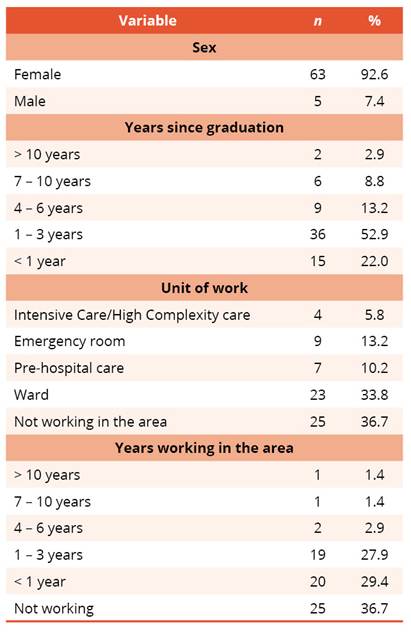
The participants were 52 students from the postgraduate course in Emergency and Urgent Care Nursing and 16 from the Intensive Care and High Complexity course, totaling 68 participants. 92.6% of the participants were female, with the predominant age range between 20 and 30 years. Regarding the length of time since graduation, 52.9% of the students have between one and three years of experience, and 36.8% do not work in the nursing field (Table 1).
Table 1. Sociodemographic and professional characteristics of the participants. Salvador - BA - 2024 (n=68)
Of the participants, 40 (58.8%) had classes on the topic during their undergraduate studies, 16 (23.5%) during their postgraduate studies, and 12 (17.6%) had no classes on brain death. All stated that it is important for nurses to have knowledge of the protocol for diagnosing BD. However, only 11 (16.2%) feel very confident to participate in the implementation of the protocol, 13 (19.1%) feel confident, and 44 (64.7%) feel somewhat confident.
Table 2 presents the nurses' knowledge (in number of correct answers) about the brain death protocol. Regarding the requirements necessary to initiate the brain death protocol, 66.2% of the participants were correct. However, 63.2% did not know how to identify the correct procedures for determining brain death, and 70.6% did not know how to indicate the purpose of the complementary examination to confirm the diagnosis of brain death. Despite the low percentage of correct answers to questions related to the topic, 100% of participants believe in the importance of nurses mastering the protocol.
Table 2. Participants' knowledge of the brain death protocol. Salvador - BA - 2024 (n=68)

The main challenges reported by participants during the BD diagnosis process were communicating brain death to the family (25%) and lack of professional knowledge (11.7%). Interestingly, 22% were unable to identify a challenge (Table 3).
Table 3. Main challenges during the brain death diagnosis process, according to participants. Salvador - BA - 2024 (n=68)
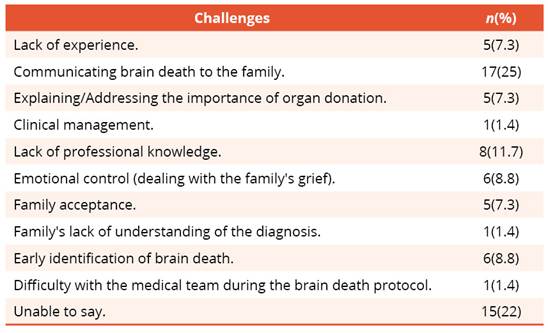
Note: one participant cited more than one challenge during the brain death diagnosis process.
Regarding the management of potential organ donors, it was found that 22 participants (32.4%) reported that the topic was covered in the classroom during their undergraduate studies; 11 (16.2%) during postgraduate studies; and 35 (51.5%) stated that they did not experience the subject while they were students. In contrast, only 2.9% feel very confident to participate in the implementation of guidelines for maintaining potential donors, 13.2% feel confident, and 83.8% feel somewhat confident. All respondents ratified the importance of continuous training on the management of potential donors.
Table 4 presents the nurses' knowledge (in number of correct answers) about the management of potential donors. Among the main points, it is noteworthy that 61.8% of the participants demonstrated knowledge about the criteria used to identify a potential donor, as well as the necessary care to maintain organ viability, with 85.3% correct answers. However, 63.2% of participants were unable to identify the target for maintaining O2 saturation, 26.5% were mistaken about the appropriate body temperature, and 29.4% were unable to identify correctly endocrine, electrolyte, and nutritional management. The percentage of participants who stated they did not know the answer is particularly noteworthy.
Table 4. Knowledge of participants regarding the management of potential organ donors. Salvador - BA - 2024 (n=68)

The participants' perception of family refusal for organ donation indicated that the main reason was a lack of knowledge about the diagnosis (80.9%), followed by religious reasons (48.5%) and unpreparedness of health professionals (20.6%).
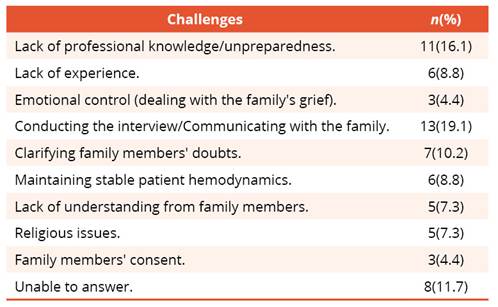
Concerning the challenges perceived by the participants in managing the potential donor (Table 5), aspects related to the nurse's competencies were highlighted, such as lack of knowledge, unpreparedness, lack of experience, emotional control, and communication skills. It is noteworthy that 8.8% stated that direct care for the maintenance of the potential donor was a challenge, and 11.7% did not know how to indicate the challenges related to the subject.
Table 5. Main challenges for participants in managing potential donors, according to the participants. Salvador – BA - 2024 (n=68)
4. Discussion
To support the discussion of the results obtained in this study, the recommendations of Resolution No. 2,173/20173, of the Federal Council of Medicine and the Guidelines of the Brazilian Association of Intensive Care Medicine were taken into consideration7.
The results of this research indicate that nurses' knowledge of the brain death protocol is weak, corroborating global studies that identify similar challenges in understanding the diagnostic criteria1,2. However, Costa et al.13 , in a study conducted with a multidisciplinary team from an intensive care unit, identified that most of the professionals interviewed demonstrated adequate knowledge about the procedures necessary to initiate the brain death protocol, as well as about the clinical and complementary examinations for establishing the diagnosis. This discrepancy highlights the heterogeneity in the training and experience of the professionals evaluated.
Regarding clinical and complementary examinations, the participants in this study were able to answer correctly, demonstrating that nurses are familiar with most of the examinations and tests to be performed to confirm the diagnosis of brain death, corroborating the findings of the qualitative study conducted with nurses working in the adult intensive care unit, in agreement with a qualitative study conducted with intensive care nurses, whose discourse showed mastery of the clinical and complementary examinations necessary to ascertain brain death14.
The results of this study revealed that the respondents' knowledge about maintaining the viability of a potential donor's organs is below what is desired. It is worth highlighting that the lack of adequate training and insufficient knowledge of professionals are factors that hinder the organ donation process, negatively affecting the effectiveness of transplants15.
Clinical management of potential donors involves a set of procedures and care essential to preserving the functional integrity of organs intended for transplantation7. Nevertheless, the results of this study demonstrate that participants' knowledge of the parameters necessary for stabilizing oxygen saturation is still incipient. In this scenario, the leading role of the nurse in regulating ventilatory variables stands out, a fundamental intervention to ensure the quality of the grafts to be transplanted5,16.
Regarding the maintenance of body temperature, a large number of the nurses interviewed (38.3%) are unaware of the guidelines. A study on the health team's knowledge of the brain death protocol and maintenance of potential donors found even higher percentages (63.6%), related to the knowledge gap among nurses14. Another study corroborates this qualitatively, indicating that hemodynamic and thermal maintenance is one of the areas with the greatest knowledge deficit15.
Regarding the proper management of endocrine, electrolyte, and nutritional aspects, almost half of the participants were unable to answer regarding the goals to be achieved for maintaining the potential donor. Research conducted among a multidisciplinary team working in an intensive care unit also found a reduction in the level of knowledge about the subject, especially among nurses16. The knowledge gap among healthcare teams to work in this scenario was identified in several studies that highlighted the weaknesses in the knowledge of critical care unit teams related to the organ and tissue donation process and the lack of formal training/capacity building on the subject8,14,15.
The participants' perception of the challenges faced in managing the potential donor pointed to the need for the development of professional competencies in a major way. Inadequate maintenance of the potential donor can limit both the number of effective donations and the quality of transplanted organs. Thus, the knowledge of the healthcare team represents an essential factor for the success and quality of care provided, requiring that each team member understands their role in preserving the viability of organs and tissues14. Corroborating this perspective, Akbulut et al.12 demonstrated that higher levels of knowledge are associated with more favorable attitudes and greater engagement of nurses in the organ donation process.
Another challenge highlighted by the participants in this study was communication with the family of the potential donor. This result was similar to that of another study that evaluated obstacles faced by nurses in caring for patients declared brain dead, and which concluded that communication with the family member was one of the main challenges17. It is reiterated that insufficient training and knowledge constitute a relevant limiting factor in the donation process16. Another equally relevant aspect is that the nurse is considered a link between the health team and the family, being fundamental in the family approach and support during the donation process13,16.
The current panorama of unfulfilled organ and tissue donations in Brazil reflects the need for greater training of health professionals, both for greater speed and assertiveness in establishing the diagnosis of brain death, and for maintaining the potential donor18. In this context, a randomized controlled trial demonstrated that structured educational interventions promoted significant improvements in the knowledge, attitudes, and behavior of nursing students regarding organ donation and transplantation19. This finding reinforces that systematized pedagogical strategies can produce a concrete impact on professional qualifications.
Thus, the implementation of structured continuing education programs focused on brain death and the organ donation process becomes essential, especially for nurses working in critical care units.
This study presents some limitations related to the period, the convenience sample, and its size, which limit the generalization of the results to other contexts and different professional profiles. Furthermore, self-reports can lead to response bias, as participants may overestimate or underestimate their own knowledge and confidence in applying the protocols.
5. Conclusion
The study reveals that nurses have significant knowledge gaps regarding both the diagnosis of brain death and donor management, demonstrating that contact with the topic during academic training is insufficient, given the complexity of the processes involved.
Furthermore, the manifested professional insecurity may constitute a silent obstacle, possibly influencing family refusal rates and organ loss due to clinical instability. In this sense, the nurse emerges as a central figure, whose technical and emotional preparation seems to be the key to a more humanized and safe approach.
Therefore, investment in continuing education strategies presents itself as a promising path to strengthening the self-confidence of these professionals, improving both clinical care and sensitive support for families.
Acknowledgments
The authors would like to thank Bahiana School of Medicine and Public Health (Escola Bahiana de Medicina e Saúde Pública - BAHIANA) for the institutional and academic support provided for the development of this study, particularly for offering infrastructure and encouraging scientific production. The authors also thank all study participants whose voluntary collaboration was essential for data collection and the development of this research.
Authors’ contributions
The authors declared that they made substantial contributions to the work in terms of the conception or design of the research; the acquisition, analysis, or interpretation of data for the work; and the writing or critical revision of relevant intellectual content. All authors approved the final version to be published and agreed to assume public responsibility for all aspects of the study.
Competing interests
No financial, legal, or political conflicts involving third parties (government, private companies and foundations, etc.) have been declared for any aspect of the submitted work (including, but not limited to, grants and funding, participation on advisory boards, study design, manuscript preparation, statistical analysis, etc.).
Indexers
The Journal of Contemporary Nursing is indexed by DOAJ and EBSCO.
References
1. Spears W, Mian A, Greer D. Brain death: a clinical overview. J Intensive Care. 2022;10(1):16. https://doi.org/10.1186/s40560-022-00609-4
2. Portaria GM/MS Nº 5.612, de 23 de outubro de 2024 (Brazil). Dispõe sobre a execução da Resolução GMC nº 25/23, de 14 de setembro de 2023, do Grupo Mercado Comum, que aprova os requisitos de boas práticas para diagnóstico de morte encefálica. [Internet]. Ministério da Saúde. Available from: https://bvsms.saude.gov.br/bvs/saudelegis/gm/2024/prt5612_24_10_2024.html
3. Resolução nº 2.173/2017, de 23 de novembro de 2017 (Brazil). Define os critérios do diagnóstico de morte encefálica. [Internet]. Diário Oficial da União. Available from: https://saude.rs.gov.br/upload/arquivos/carga20171205/19140504-resolucao-do-conselho-federal-de-medicina-2173-2017.pdf
4. Registro Brasileiro de Transplantes (RBT). Dimensionamento dos Transplantes no Brasil e em cada estado. Registro Brasileiro de Transplantes (2016-2023) [Internet]. São Paulo: Associação Brasileira de Transplante de Órgãos (ABTO); 2023. p. 6–26. Available from: https://site.abto.org.br/wp-content/uploads/2024/04/rbt2023-restrito.pdf
5. Furtado LBS, Moraes Filho IM, Sousa TV, Roure JGR, Lima TP, Arantes AA, et al. The role of the nurse in front of cases of brain death and donation of organs and tissues. Res Soc Dev. 2021;10(2):e0110212422. https://doi.org/10.33448/rsd-v10i2.12422
6. Saxena D, Trivedi P, Bhavsar P, Memon F, Thaker A, Chaudhary C, et al. Challenges and Motivators to Organ Donation: A Qualitative Exploratory Study in Gujarat, India. Int J Gen Med. 2023;16:151-9. https://doi.org/10.2147/IJGM.S393240
7. Westphal GA, Robinson CC, Cavalcanti AB, Gonçalves ARR, Guterres CM, Teixeira C, et al. Brazilian guidelines for the management of brain-dead potential organ donors. The task force of the Associação de Medicina Intensiva Brasileira, Associação Brasileira de Transplantes de Órgãos, Brazilian Research in Critical Care Network, and the General Coordination of the National Transplant System. Rev Bras Ter Intensiva. 2021;33(1):1–11. https://doi.org/10.5935/0103-507X.20210001
8. Bastos VS, Lima AMSA, Maramaldo ICR. Nurses’ Knowledge about Potential Donor Maintenance in the Intensive Care Unit. Braz J Transplant. 2025; 28:e4325. https://doi.org/10.53855/bjt.v28i1.724_PORT
9. Bergiante NCR, Meza LA, Alves IC, Accioly JVC. A multimethodological approach to organ donation logistics: systemic analysis of Brazilian federal units through qualitative system dynamics and efficiency assessment using data envelopment analysis. Pesqui Oper. 2024;44:e276126. https://doi.org/10.1590/0101-7438.2023.043.00276126
10. Rodrigues SLL, Boin IFSF, Zambelli HJL, Sardinha LAC, Ataíde EC, Fernandes MEN. Factors related to the non-authorization of organ and tissue donation by the families who refused organ donation. Braz J Transpl. 2021;24(4):10-8. https://doi.org/10.53855/bjt.v24i4.429
11. Al-Fatlawi AM, Alkhaqani AL, Alroubaey DAA. Nurses’ Knowledge about the Brain Death Criteria: A Cross-Sectional Study. International Journal of Immunology and Nursing Dynamics. 2025;1(2):7-18. https://doi.org/10.46610/IJIND.2025.v01i02.002
12. Akbulut S, Demyati K, Tamer M, Unsal S, Beyoglu S, Saritas H. Knowledge levels, attitudes, and awareness of nurses toward organ donation. North Clin Istanb. 2022;9(4):367-75. https://doi.org/10.14744/nci.2022.24478
13. Costa VC, Nascimento MML, Silva JEL, Silva BCV, Melo NRM, Guimarães TMRG. Conhecimento da equipe de saúde sobre protocolo de morte encefálica e manutenção do potencial doador. Revista de Pesquisa Cuidado é Fundamental Online [Internet]. 2021;13:1499–505. Available from: https://seer.unirio.br/cuidadofundamental/article/view/10229
14. Dana GA, Almeida CG, Souza LA, Tavares SS, Contini ICP. Nurses' knowledge about the process of diagnosis and hemodynamic maintenance in brain-dead patients: an opinion survey. Rev Saúde Foco [Internet]. 2023;15:120-32. Available from: https://portal.unisepe.com.br/unifia/wp-content/uploads/sites/10001/2023/03/CONHECIMENTO-DOS-ENFERMEIROS-SOBRE-O-PROCESSO-DE-DIAGNO%CC%81STICO-E-MANUTENC%CC%A7A%CC%83O-HEMODINA%CC%82MICA-NOS-PACIENTES.pdf
15. Roth NT, Åkerman E. Critical Care Nurses’ Perceptions and Experiences of the Organ Donation Process: A Systematic Review. Nurs Open. 2026;13(1):e70420. https://doi.org/10.1002/nop2.70420
16. Watanabe RA, Araújo CM, Rodrigues VT, Bezerra JKM. Knowledge of the multiprofessional team about the clinical management of the potential donor. Rev Cient Esc [Internet]. 2024;10:1-7. Available from: https://www.revista.esap.go.gov.br/index.php/resap/article/view/769/447
17. Cavalcanti NB, Silva ACM, Nascimento JWA. Brain death: nurses' knowledge and obstacles regarding care. Brazilian Journal of Health Review. 2021;4(1):2586–99. https://doi.org/10.34119/bjhrv4n1-208
18. Oliveira AFCG, Cardoso RAB, Freitas KC, Lotte EJ, Lucas BL. Gaps and Obstacles to Organ Donation in Brazil: A Literature Review. Braz J Transplant. 2023;26:e2723. https://www.scielo.br/j/bjt/a/L4hh8XyJ4HMKkqyMxPN6pvS/?format=pdf&lang=pt
19. Bas-Sarmiento P, Coronil-Espinosa S, Poza-Méndez M, Fernández-Gutiérrez M. Intervention programme to improve knowledge, attitudes, and behaviour of nursing students towards organ donation and transplantation: A randomised controlled trial. Nurse Educ Pract. 2023;68:103596. https://doi.org/10.1016/j.nepr.2023.103596
