Literature review
Contributions of point-of-care ultrasound (POCUS) in intensive care nursing: an integrative review / Contribuições do ultrassom point-of-care (POCUS) na assistência de enfermagem intensivista: uma revisão integrativa
Flávia Almeida dos Santos1 (https://orcid.org/0009-0002-1207-2231)
Tássia Nery Faustino2 (https://orcid.org/0000-0001-7854-4540)
Nabila Monalisa Mendes Dantas Sales3 (https://orcid.org/0000-0002-1912-7859)
Vanessa Nascimento Batista4 (https://orcid.org/0009-0003-7691-6461)
Douglas de Souza e Silva5 (https://orcid.org/0000-0003-4476-7767)
1Corresponding contact. Universidade do Estado da Bahia (Salvador). Bahia, Brazil. [email protected]
2-4Universidade do Estado da Bahia (Salvador). Bahia, Brazil.
5Universidade do Estado da Bahia (Guanambi). Bahia, Brazil.
ABSTRACT | OBJECTIVE: To analyze the scientific production on the main contributions of the use of point-of-care ultrasound (POCUS) in intensive nursing care. METHOD: Integrative literature review (period: February to July 2024), conducted through an electronic search in the LILACS and PubMed databases, covering primary studies in full text in which POCUS was performed by nurses, in Portuguese and English. The recommendations of the Preferred Reporting Items for Systematic Reviews and Meta-Analyses (PRISMA) were followed. RESULTS: A total of 806 papers were found; 11 were included in this study, mostly published in 2022 (n=3) and in English (n=8). The main contributions of using POCUS in nursing care were: guidance for the insertion and confirmation of the location of invasive devices (venous and arterial catheters and feeding tubes), assessment of cardiac and pleural changes, measurement of gastric and bladder volume, and the prevention, detection, and monitoring of pressure injuries. CONCLUSION: POCUS is established as a tool for inserting and confirming invasive device placement and assessing clinical changes. It is consolidating itself as an innovative practice that strengthens the autonomy and safety of intensive care nursing in the care of critically ill patients.
KEYWORDS: Nursing Care. Nursing. Ultrasound. Intensive Care Units.
RESUMO | OBJETIVO: Analisar a produção científica sobre as principais contribuições do uso do ultrassom point-of-care (POCUS) na assistência de enfermagem intensiva. MÉTODO: Revisão integrativa da literatura (período: fevereiro a julho de 2024), realizada por meio de pesquisa eletrônica nas bases de dados LILACS e PubMed, abrangendo estudos primários em texto completo nos quais o POCUS fosse realizado por enfermeiros, nos idiomas português e inglês. Foram seguidas as recomendações do Preferred Reporting Items for Systematic Reviews and Meta-Analyses (PRISMA). RESULTADOS: Foram encontrados 806 artigos; 11 foram incluídos neste estudo, em sua maioria publicados em 2022 (n=3) e em inglês (n=8). As principais contribuições do uso do POCUS na assistência de enfermagem foram: guia para a inserção e confirmação da localização de dispositivos invasivos (cateteres venosos e arteriais e sondas para alimentação); avaliação de alterações cardíacas e pleurais; mensuração de volume gástrico e vesical; e a prevenção, detecção e monitoramento de lesão por pressão. CONCLUSÃO: O uso do POCUS configura-se como uma ferramenta para a inserção e a confirmação da localização de dispositivos invasivos, bem como para a avaliação de alterações clínicas. Consolidando-se como uma prática inovadora que fortalece a autonomia e a segurança da enfermagem intensivista na assistência ao paciente crítico.
PALAVRAS-CHAVE: Cuidados de Enfermagem. Enfermagem. Ultrassonografia. Unidades de Terapia Intensiva.
How to cite this article: Santos FA, Faustino TN, Sales NMMD, Batista VN, Silva DS. Contributions of point-of-care ultrasound (POCUS) in intensive care nursing: an integrative review. J Contemp Nurs. 2026;15:e6718. https://doi.org/10.17267/2317-3378rec.2026.e6718
Submitted Jan. 23, 2026, Accepted May 7, 2026, Published June 11, 2026
J. Contemp. Nurs., Salvador, 2026;15:e6718
https://doi.org/10.17267/2317-3378rec.2025.e6718
Assigned editors: Cátia Palmeira, Tássia Macêdo
1. Introduction
The Intensive Care Unit (ICU) is a hospital unit considered a highly complex setting, intended for the care of patients in critical condition who require specific interventions and specialized assistance1. This setting has a multidisciplinary care team composed of professionals from different categories, including nursing professionals. The nursing team comprises nursing technicians and nurses, who are responsible for providing individualized, holistic, and humanized care and for direct care throughout the patient’s stay in this setting2.
Thus, in the daily routine of this sector, the nursing professional is responsible for performing various activities of high or low complexity, such as monitoring hemodynamic, neurological, and ventilatory parameters, administering medications and solutions, performing invasive procedures, and evaluating and monitoring the patient’s clinical status. Thus, it is essential to have competence and security in the practice of care3.
 Recently, nurses
have used technological resources to support their care practices, especially
in intensive care, which requires greater clinical surveillance and continuous
monitoring, thereby enabling rapid and accurate analysis of clinical conditions4.
These technologies contribute to a faster, more accurate, and safer
clinical assessment of health conditions. Among these resources, the use of
point-of-care ultrasound (POCUS) stands out, a technology that employs
non-ionizing radiation, that is, low frequency and low energy, making it
possible to visualize body structures through sound waves. Therefore, it is
considered a safe, painless, economical, and non-invasive exam5.
Recently, nurses
have used technological resources to support their care practices, especially
in intensive care, which requires greater clinical surveillance and continuous
monitoring, thereby enabling rapid and accurate analysis of clinical conditions4.
These technologies contribute to a faster, more accurate, and safer
clinical assessment of health conditions. Among these resources, the use of
point-of-care ultrasound (POCUS) stands out, a technology that employs
non-ionizing radiation, that is, low frequency and low energy, making it
possible to visualize body structures through sound waves. Therefore, it is
considered a safe, painless, economical, and non-invasive exam5.
In nursing, POCUS has
multiple applications in clinical practice, such as aiding the performance of
physical examinations, measuring urine volume and gastric residue, and
performing venous and arterial punctures6. Thus, nurses have
legal support to perform this exam, as long as they have specific training, and
the issuance of a report is prohibited, as well as the use of this
technological resource for diagnostic purposes7.
Using POCUS in the intensive care setting offers advantages for patient and profession al care, as it enables the acquisition of crucial information that guides the execution of technical procedures8. Thus, it contributes to nurses having greater autonomy in taking conduct aimed at the patient’s well-being and safety, in addition to allowing the qualification of care, since the use of this tool complements the nursing care practice9.
In view of the lack of published studies that summarize the indications for the use of POCUS in nursing care for critically ill patients, this research is justified by the need to strengthen the scientific basis that supports the use of this tool in clinical practice, contributing to the qualification of care, the reduction of adverse events, and the promotion of better health outcomes10. In addition, the study is relevant because it investigates the use of a technological resource that directly contributes to advanced nursing practices aimed at establishing excellent care and obtaining better results for patients, families, and health services2,8.
By demonstrating the
potential of POCUS, this research also supports expanding the scope of nurses’
activities, aligning them with contemporary demands for innovation
problem-solving capacity, and safety in health services, and collaborating with
the development of an increasingly technological, critical, and evidence-based
nursing11. In this context, this research aimed to analyze
the scientific production on the main contributions of the use of POCUS in
intensive care.
2. Method
This is an integrative literature review, conducted in accordance with the recommendations proposed in the Preferred Reporting Items for Systematic Reviews and Meta-Analyses (PRISMA), adapted for an integrative review12. The following guiding question for the electronic survey was defined: “How can the use of POCUS collaborate with nursing care in the Intensive Care Unit?” The PICo13 strategy was used to elaborate it, in which “P” (population) corresponds to critically ill patients, “I” (phenomenon of interest) to the contributions of POCUS use, and “Co” (context) to nursing care in the ICU.
As eligibility criteria, we included primary studies available in full, in Portuguese and English, that addressed the use of POCUS by nurses in the intensive care setting, with no time limit. The inclusion of primary studies is justified by the need to obtain empirical evidence directly related to the phenomenon under investigation. The language restriction was adopted due to operational feasibility and adequate understanding of the studies. Theses, dissertations, opinion articles, editorials, letters to the editor, and case studies were excluded. Studies aimed at pediatric and neonatal populations were also excluded, considering the physiological, clinical, and care specificities different from those of the critical adult public, which could compromise the homogeneity of the analysis.
The bibliographic survey was conducted from February to July 2024 in the Medical Literature Analysis and Retrieval System Online (MEDLINE) via PubMed and the Latin American and Caribbean Literature on Health Sciences (LILACS) databases. The choice of these databases is justified by their wide coverage of the international biomedical literature and the representativeness of scientific production from Latin America and the Caribbean. Specifically, this allows us to contemplate both global and regional evidence relevant to nursing practice.
To develop the search strategy, the Health Sciences Descriptors (DeCS) and the Medical Subject Headings (MeSH) were used, combined with natural language terms through Boolean operators (AND and OR), aiming to increase the sensitivity and reach of the search. The same search strategy was adopted in the two chosen databases: The descriptors in Portuguese “Enfermagem” OR “Cuidados de Enfermagem” AND “Ultrassonografia” AND “Unidades de Terapia Intensiva” OR “Enfermagem em Cuidados Intensivos” OR “Cuidados Críticos” and the descriptors in English “Nursing” OR “Nursing Care” AND “Ultrasonography” AND “Intensive Care Units” OR “Critical Care Nursing” OR “Critical Care”.
In the process of selecting the studies, the Mendeley software was used to organize references and the Rayyan14 platform was used to identify and remove duplicates. Two independent reviewers conducted the screening process, in a blind manner, which ensured greater methodological rigor and reduced biases in selecting the studies. Initially, the titles and abstracts were read, and, subsequently, the potentially eligible articles were read in full. In cases of disagreement between the reviewers, the differences were solved by consensus between the two evaluators, through careful reanalysis of the eligibility criteria.
The studies were finally selected after the texts were fully read, and the selection was concluded in July 2024. The citations present in the included studies were also analyzed, and those that met the eligibility criteria were included in this review. Next, data were extracted using a previously developed tool, which included information such as authors, year of publication, objective, method, main results, and conclusions.
Regarding the evaluation of the methodological quality of the included studies, no specific checklist was adopted. This decision is based on the nature of the integrative review, which allows the inclusion of diverse methodological designs and prioritizes the broad analysis of the knowledge produced15. However, a critical analysis of the studies regarding methodological consistency, clarity of objectives, adequacy of methods, and relevance of findings for nursing practice was carried out.
The findings were then interpreted and summarized, enabling identification of the main contributions of POCUS in intensive care nursing, as well as gaps in scientific knowledge. Finally, the final considerations were developed, consolidating the main results of the integrative review.
3. Results
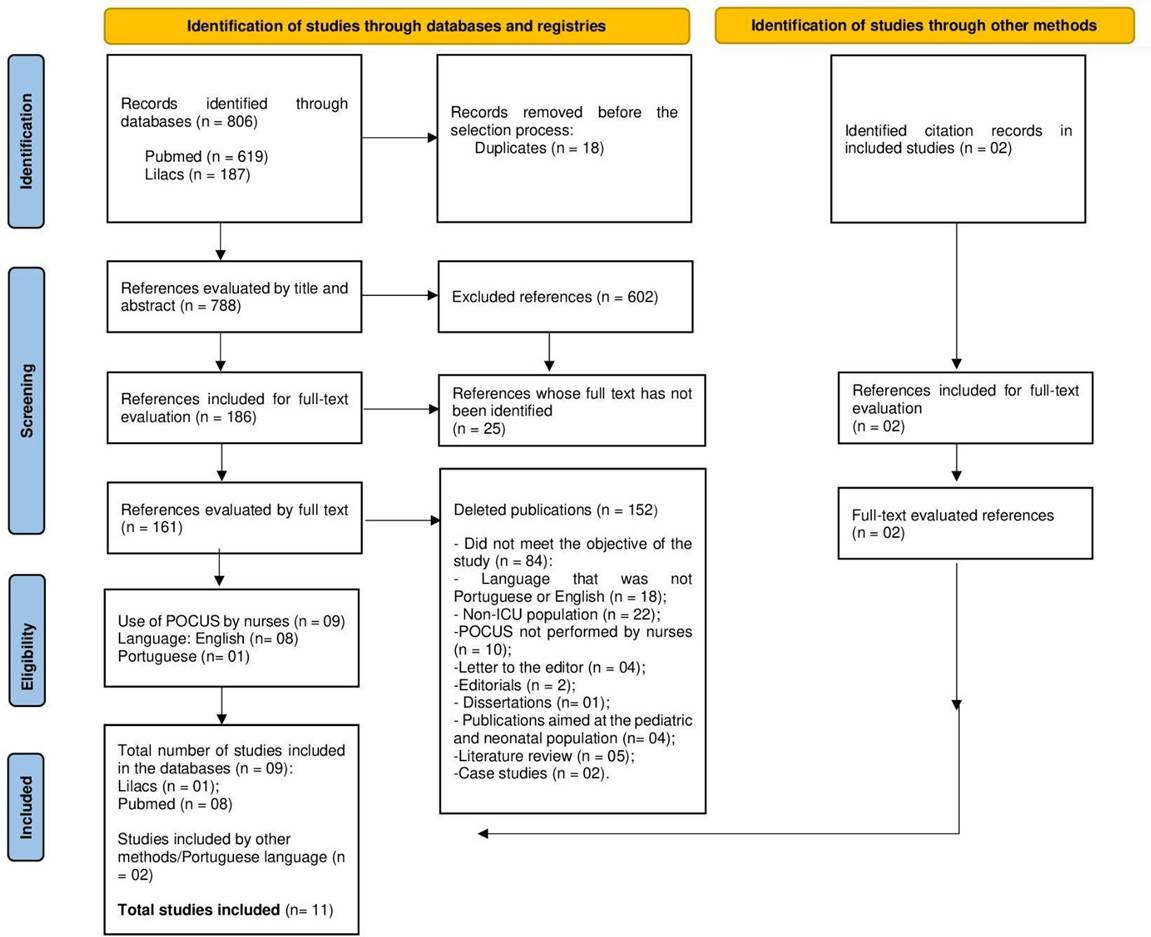
Of the 806 studies found, 18 were excluded due to duplication, leaving 788 for titles and abstract reading. Of these, 25 full texts were not identified, leaving 161 available for analysis. After this stage, nine studies met the eligibility criteria. Subsequently, two publications were identified from citations in studies already included that met the eligibility criteria. At the end of this process, 11 studies were included. Figure 1 shows the search and selection process for the studies included in this review.
Figure 1. Flowchart of the steps of identification and selection of studies for the integrative review
Adapted from: Page MJ, McKenzie JE, Bossuyt PM, Boutron I, Hoffmann TC, Mulrow CD, et al. The PRISMA 2020 statement: an updated guideline for reporting systematic reviews. BMJ. 2021;372:n71.12
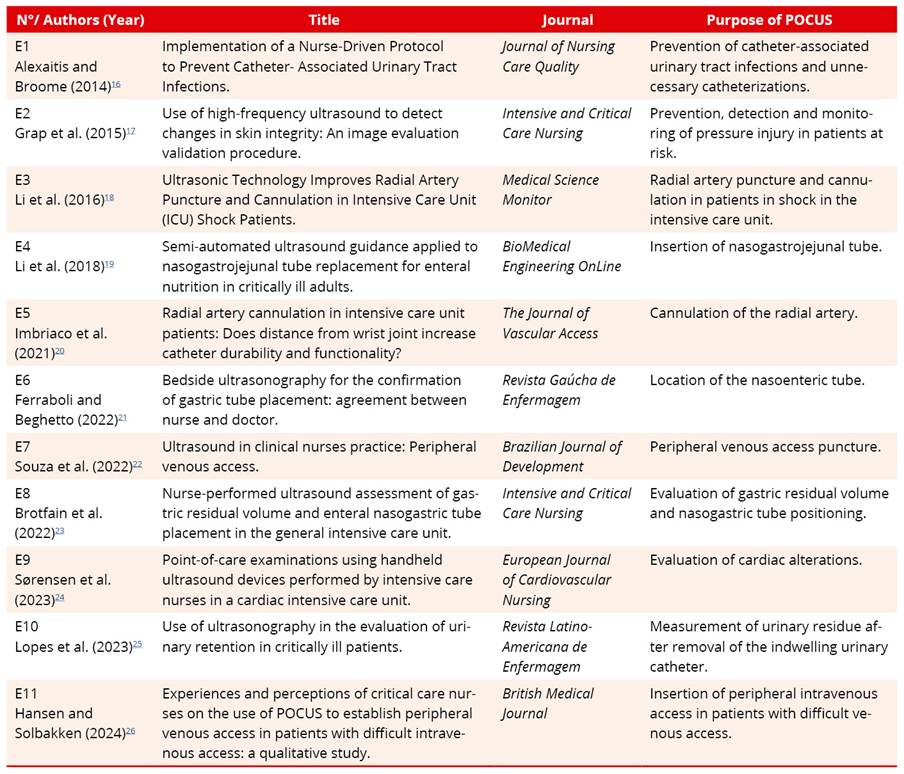
Table 1 summarizes the characterization of the 11 selected papers, mostly published in 2022 (n=3) [E6, E7, E8], in English (n=8) [E1-E5, E8, E9, E11]. Regarding the large area of publication, almost all studies were published in medical journals (n=7) [E2, E3-E5, E7, E8, E11], followed by nursing journals (n=4) [E1, E6, E9, E10].
Regarding the purpose of the use of POCUS, there is a wide variety of clinical applications, among them the prevention, detection, and monitoring of pressure injuries in patients at risk [E2]; prevention of catheter-associated urinary tract infections (CAUTIs) and unnecessary catheterizations [E1]; measurement of urinary residue after removal of the indwelling urinary catheter [E10]; puncture and cannulation of the radial artery in patients in shock [E3, E5]; evaluation of gastric residual volume and positioning of the nasogastric tube [E8]; insertion of a nasogastrojejunal tube [E4]; location of the nasoenteric tube [E6]; peripheral venous access puncture in patients with difficult venous access [E7, E11]; and evaluation of cardiac and pleural alterations [E9].
Table 1. Characterization of the studies included in the integrative literature review
POCUS - Point-of-Care Ultrasound.
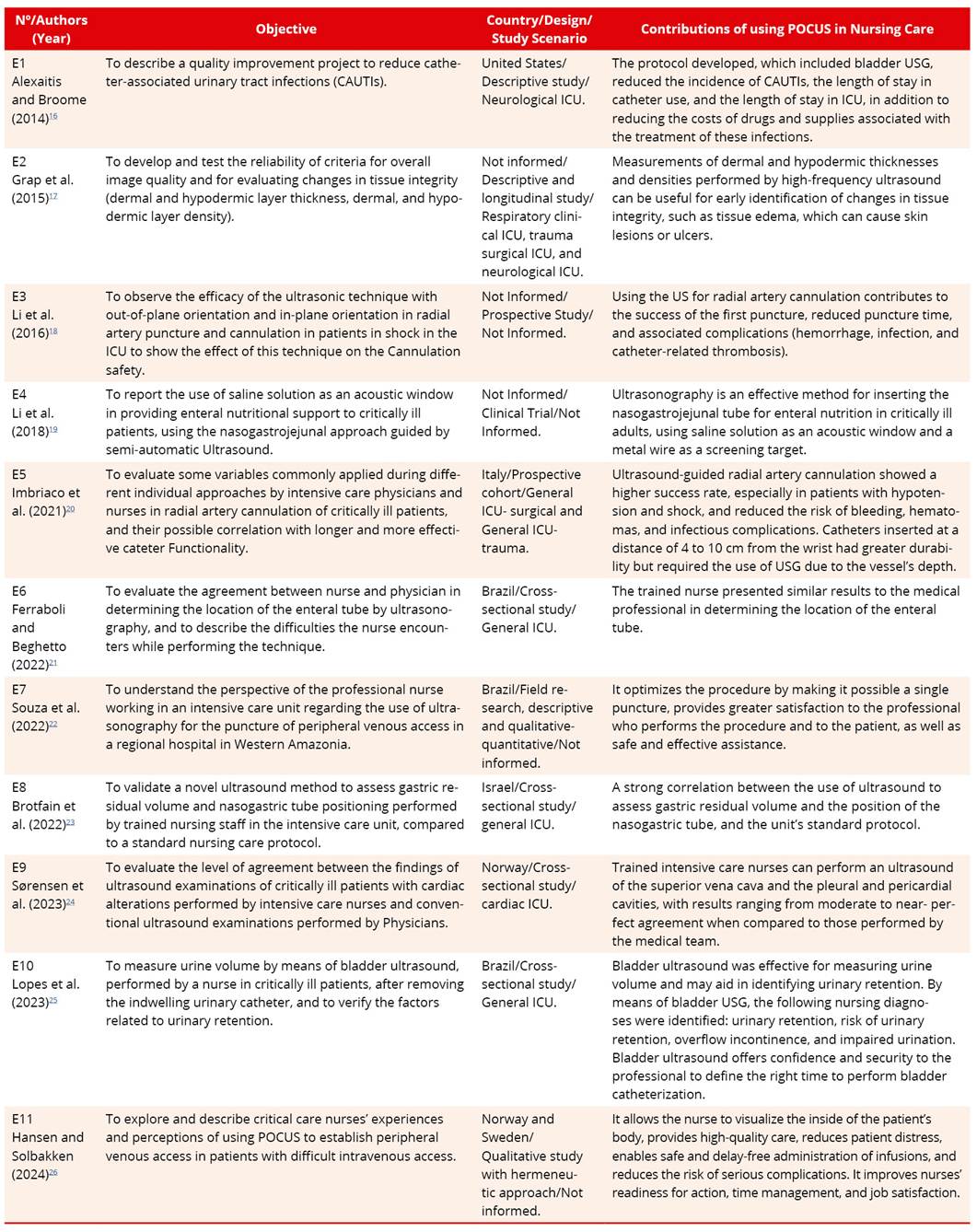
Regarding the characteristics of the studies analyzed, there was a variety of international studies (n=5) [E1, E5, E8, E9, E11], but Brazil had the highest number of records (n=3) [E6, E7, E10]; the most used research designs were cross-sectional studies (n=4) [E6, E8, E9, E10], followed by descriptive studies (n=3) [E1, E2, E7]. Regarding the study scenario, most papers had the General ICU (n=4) [E5, E6, E8, E10] and the Neurological ICU (n=2) [E1, E2] as the locus of research (Table 2).
Regarding the contributions of POCUS to intensive care nursing care, the use of this tool makes it possible to visualize the venous network, leading to success in the insertion of peripheral venous access in patients with puncture difficulties (n=2) [E7, E11], reducing patient suffering and the risk of complications. Additionally, it beneficially influences time management and nurses’ professional satisfaction (n=2) [E7, E11]. In addition, two studies reported the use of this technology for radial artery cannulation, contributing to its success [E5] and to reducing procedure time and the risk of associated complications [E3, E5].
Table 2. Results found in the studies included in the integrative literature review
CAUTIs - Catheter-associated Urinary Tract Infections; UGS - Ultrasonography; ICU - Intensive Care Unit.
Three papers [E4, E6, E8] showed positive results when evaluating the use of POCUS as a guide for nasogastrojejunal tube insertion, for determining the location of nasogastric and nasoenteric tubes, as well as for measuring gastric residual volume. Two studies evaluated the use of ultrasound to identify possible alterations in the genitourinary system [E1, E10]. A single study [E9] mentioned that properly trained intensive care nurses can use POCUS to evaluate the superior vena cava and the pleural and pericardial cavities. Study E2 indicated that changes in the density of the dermal or hypodermic layer identified by ultrasonography means tissue inflammation caused by the deprivation of oxygen and other nutrients.
4. Discussion
This integrative review summarized the results of 11 studies on the contributions of POCUS to intensive care nursing care, identifying the broad clinical applicability of this resource. Nurses who have specific training in ultrasonography can perform the examination at the bedside, as this tool supports the performance of care of greater technical complexity, thus being an innovation in nursing practice7.
A total of four studies [E3, E5, E7, E11]18,20,22,26 described the use of POCUS to guide vein and artery puncture. It is known that critically ill patients are susceptible to shock situations and, in these cases, their hemodynamic parameters become unstable, requiring blood pressure to be continuously monitored, as well as serial collection of blood gases and lactate dosage, which is provided by introducing a catheter into an artery27. The trained nurse is authorized to perform the arterial puncture procedure for these purposes and can thus use POCUS to support this practice28.
Studies indicate that the use of POCUS is a promising practice for venipuncture, especially in individuals with difficulty in visualizing the venous network, such as geriatric, dehydrated and/or capillary fragility patients, as it allows the professional to visualize the exact location of the blood vessel and select the vein with the appropriate diameter and length11,29. In addition, other studies report that using this tool minimizes possible complications caused by excessive attempts, allowing real-time visualization of the punctured area, thus increasing the success rates of the procedure on the first attempt22,26.
A study carried out in a General ICU in Brazil mentions that bladder ultrasonography performed by a nurse, by means of POCUS, can be considered a complement to the physical examination, being useful to measure urine volume, thus favoring the early detection of urinary retention, characterized by the accumulation of urine above 400 ml in adults25. In addition, another study reports that using this resource can help nurses in analyzing diuresis, helping to evaluate the need to perform bladder catheterization, since using this device indiscriminately or for a long time increases the risk of infections, urethral injury or stenosis, and hematuria30. Thus, POCUS is an effective tool in assessing urine volume and substantially reduces the use of indwelling urinary catheters (IUC), as well as making it possible to determine which patients have a real indication for their insertion and when is the appropriate time to perform a relieving urinary catheterization25,30.
In addition to the urinary system, studies have also addressed other areas of POCUS application. For example, a study conducted in Norway showed the use of POCUS to evaluate cardiac patients during physical examination24. This evaluation allows the early identification of relevant changes, such as pleural and pericardial effusions, even before changes in vital signs. This way, the application of POCUS favors continuous monitoring and the decision together with the medical team on immediate local drainage24.
The use of POCUS is considered a safe, innovative, and effective practice for ICU nurses in evaluating gastric residual volume and nasogastric tube positioning, as it enables monitoring nutritional tolerance, preventing regurgitation, and detecting the risk of bronchial aspiration23. Considering that critically ill patients are at higher risk of bronchial aspiration due to reduced gastrointestinal motility, evolution with dysphagia and/or esophageal reflux, as well as needing to use enteral diet, invasive mechanical ventilation, and central nervous system depressant medications, it is important to verify residual gastric volume, contributing to care surveillance in the intensive care setting31,32.
Currently, POCUS has been
used as an alternative to verify the positioning of the nasoenteric tube19,21,23.
This alternative allows the device’s path to be evaluated in real time, without
requiring patient displacement or radiation exposure19,21. Although
radiography remains the gold standard for confirming the position of
gastrointestinal tubes21.
In addition, it is known that individuals admitted to the ICU usually undergo daily X- rays of the thoracic region to check the position of the orotracheal tube, and that the constant and long-term use of ionizing radiation can lead to complications, such as organ and tissue damage and genetic mutations33. Thus, the use of POCUS is a method on the rise in intensive care and, in addition to being useful for verifying the positioning of the nasoenteric tube, it can guide its insertion34.
A descriptive, longitudinal study conducted in ICUs with different profiles (respiratory, trauma, surgical, and neurological) demonstrates the use of POCUS to prevent, detect, and monitor pressure injuries in patients at risk. This innovative tool in the field of care enables early identification of tissue alterations even before clinical signs are visible17.
In addition to the clinical applicability found in this literature review, POCUS has other functionalities for nursing in the intensive care setting, such as measuring the optic nerve sheath, enabling the evaluation of intracranial pressure, since continuous monitoring of this brain parameter is important in neurocritical patients, such as those with traumatic brain injury35.
In addition, using this tool can be useful to identify reversible causes of cardiorespiratory arrest, such as cardiac tamponade, tension pneumothorax, hypovolemia, and massive pulmonary embolism, although the literature indicates that the use of this technology may be contraindicated in this critical clinical situation, given the potential risk of it interfering with the quality and continuity of cardiopulmonary resuscitation maneuvers36.
Pulmonary POCUS is also an efficient tool for assessing blood volume in patients with acute kidney injury (AKI) and for identifying the nursing diagnosis of excess fluids, as evidenced by ultrasound-detected pulmonary congestion37.
Thus, given the wide
variety of clinical applications of POCUS, it is important to emphasize that
the use of this resource in the ICU by intensive care nurses will only be
possible with this equipment being available in this care setting, as well as
with the continuous training on the indications, technique, and interpretation
of the images provided by this
technology, thus ensuring its assertive and safe use29.
As limitations of this
review, conducting the electronic search in only two databases may have
narrowed the scope of identified relevant studies, increasing the risk of
selection bias. In addition, the scarcity of international studies on nurses’
use of POCUS highlights a scientific gap that directly affects the consistency
of the available evidence. In addition, the inclusion criteria adopted, such as
the restriction to Portuguese and English and the delimitation of the adult
population, may have led to relevant research being excluded. Similarly, the
exclusion of grey literature is a limitation, as it restricts access to
complementary evidence that is not indexed in traditional databases.
Regarding the contributions of this review, POCUS allows direct assistance in the execution of invasive procedures such as venous and/or arterial cannulation18,20,22,26,38,39, insertion of intestinal tubes, and confirmation of device positioning19,21,23,31,32. This way, it complements the physical examination, contributing directly to the recognition of possible clinical alterations and supporting the nursing assessment and diagnosis, as well as the construction of individualized care plans, aiming to promote patient safety and care quality10.
5. Final considerations
This integrative literature review identified multiple contributions of POCUS in intensive care nursing, including the management of invasive devices and the clinical evaluation of critically ill patients. In addition, using POCUS reduces the time to puncture blood vessels and the complications associated with invasive procedures. These findings can contribute to greater safety and satisfaction for the professional and the patient.
Thus, using POCUS in the intensive care setting is an innovative tool, as it benefits the establishment of higher-quality care, while providing greater autonomy and security to the professional in complex decision-making. Furthermore, continuing education should be a crucial tool for spreading the importance and use of this resource to advance nursing practice. Finally, it was evident that more studies on the topic are needed, especially field research aimed at exploring potential areas where nurses can use POCUS in the care of critically ill patients.
Authors’ contributions
The authors declared that they had made substantial contributions to the study in terms of the conception or design of the research, the acquisition, analysis, or interpretation of data for the work, and the writing or critical review of relevant intellectual content. All authors approved the study’s final version for publication and agreed to take public responsibility for all aspects of the study.
Competing interests
No financial, legal, or political conflicts involving third parties (government, private companies, and foundations, etc.) were declared for any aspect of the submitted study (including but not limited to grants and funding, advisory board membership, study design, manuscript preparation, statistical analysis, etc.).
Indexers
The Journal of Contemporary Nursing is indexed by DOAJ and EBSCO.
References
1. Dias BL, Siqueira DS. Humanization of care in intensive care units: an integrative review. Revista FT. 2023;27(125). https://doi.org/10.5281/zenodo.8302822
2. Ouchi JD, Lupo APR, Alves BO, Andrade RV, Fogaça MB. O papel do enfermeiro na unidade de terapia intensiva diante de novas tecnologias de saúde. Rev Saúde Foco [Internet]. 2018;10:412-28. Available from: https://portal.unisepe.com.br/unifia/wp-content/uploads/sites/10001/2018/07/054_O_PAPEL_DO_ENFERMEIRO_NA_UNIDADE_DE_TERAPIA_INTENSIVA.pdf
3. Venturi V, Viana CP, Maia LFS, Basílio MJ, Oliveira AV, Sobrinho JC, et al. The nurse's role in the management of hemodynamic monitoring in the intensive care unit. Revista Recien. 2016;6(17):19-23. https://doi.org/10.24276/rrecien2358-3088.2016.6.17.19-23
4. Menezes JDS, Pereira AA, Silva IS, Chiminez HM, Rodrigues CDS, Rodrigues AMS. Perspectives on the use of ultrasound by nurses in the emergency department: an integrative review. Res Soc Dev. 2022;11(9):e36511931896. https://doi.org/10.33448/rsd-v11i9.31896
5. Posses, FP. Ultrassonografia: o que é ultrassom e como funciona o exame. [Internet]. [updated 2025 Setp. 26; cited 2024 July 29]. Available from: https://star.med.br/ultrassonografia-exame-de-ultrassom/
6. Wessler AS, Cerqueira ML, Lage NM, Santos RF, Alves EK. The use of bedside ultrasound by nurses as a support tool in performing procedures of greater complexity [trabalho de conclusão de curso] [Internet]. Santa Catarina: UniSociesc; 2021. [cited 2024 Jan. 30]. Available from: https://repositorio.animaeducacao.com.br/handle/ANIMA/25727
7. Resolução do COFEN n° 679/2021, de 30 de agosto de 2021 (Brazil). Aprova a normatização da realização de Ultrassonografia à beira do leito e no ambiente pré-hospitalar por Enfermeiro. [Internet]. Conselho Federal de Enfermagem. Brasília, 2021 [citado em 2024 jan 29]. Available from: https://www.cofen.gov.br/resolucao-cofen-no-679-2021/
8. Soares, AEV. O Uso do Ultrassom Point-of-Care por Enfermeiros de Unidade de Terapia Intensiva Neonatal: Um Protocolo de Scoping Review [trabalho de conclusão de curso] [Internet]. Rio Grande do Norte: Universidade Federal do Rio Grande do Norte; 2022. [cited 2024 Apr. 15]. Available from: https://repositorio.ufrn.br/handle/123456789/49136
9. Parrela ATR. Uso da Ultrassonografia Point-of-Care para Avaliação Vesical: Capacitação Para Enfermeiros de Áreas Críticas [dissertação] [Internet]. Florianópolis: Universidade Federal de Santa Catarina; 2022. citado em 2024 abr 19]. Disponível em: https://repositorio.ufsc.br/bitstream/handle/123456789/242594/PNFR1261-D.pdf?sequence=-1
10. Santos VB, Silva WP, Apablaza MFS, Silva TV, Gimenes FRE. The use of point-of-care ultrasound in nurses’ clinical practice as a foundation for patient safety. Rev Bras Enferm. 2024;77(Suppl 2):e77suppl0201. https://doi.org/10.1590/0034-7167.202477suppl0201pt
11. Migot BM, Passos MV, Simões ASA, Marques ALM, Teodoro RMO, Faria EC. Uso do ultrassom point-of-care (POCUS) por enfermeiros: uma revisão integrativa. Revista FT. 2024;29(140). Available from: https://revistaft.com.br/uso-do-ultrassom-point-of-care-pocus-por-enfermeiros-uma-revisao-integrativa/
12. Page MJ, McKenzie JE, Bossuyt PM, Boutron I, Hoffmann TC, Mulrow CD, et al. The PRISMA 2020 statement: an updated guideline for reporting systematic reviews. BMJ. 2021;372:n71. https://doi.org/10.1136/bmj.n71
13. Araujo WCO. Health information retrieval: construction, models andstrategies. ConCI: Conv Ciênc Inform. 2020;3(2):100-34. https://doi.org/10.33467/conci.v3i2.13447
14. Ouzzani M, Hammady H, Fedorowicz Z, Elmagarmid A. Rayyan—a web and mobile app for systematic reviews. Syst Rev. 2016;5(1):210. https://doi.org/10.1186/s13643-016-0384-4
15. Souza MT, Silva MD, Carvalho R. Integrative review: what is it? How to do it? Einstein [Internet]. 2010;8(1 Pt 1):102–6. Available from: https://www.scielo.br/j/eins/a/ZQTBkVJZqcWrTT34cXLjtBx/?format=pdf&lang=pt
16. Alexaitis I, Broome B. Implementation of a Nurse-Driven Protocol to Prevent Catheter-Associated Urinary Tract Infections. J Nurs Care Qual. 2014;29(3):245-52. https://doi.org/10.1097/NCQ.0000000000000041
17. Grap MJ, Burj RS, Lucas V, Munro C, Wetzel PA, Schubert CM. Use of high frequency ultrasound to detect changes in skin integrity: An image evaluation validation procedure. Intensive Crit Care Nurs. 2015;31(3):141-7. https://doi.org/10.1016/j.iccn.2014.08.002
18. Li X, Fang G, Yang D, Wang L, Zheng C, Ruan L, et al. Ultrasonic Technology Improves Radial Artery Puncture and Cannulation in Intensive Care Unit (ICU) Shock Patients. Med Sci Monit. 2016;22:2409-16. https://doi.org/10.12659/msm.896805
19. Li Y, Ye Y, Mei Y, Ruan H, Yu Y. Semi-automated ultrasound guidance applied to nasogastrojejunal tube replacement for enteral nutrition in critically ill adults. Biomed Eng Online. 2018;17(1):21. https://doi.org/10.1186/s12938-018-0452-1
20. Imbriaco G, Monesi A, Giugni A, Cilloni N. Radial artery cannulation in intensive care unit patients: Does distance from wrist joint increase catheter durability and functionality? J Vasc Access. 2021;22(4):561-7. https://doi.org/10.1177/1129729820953020
21. Ferraboli SF, Beghetto MG. Ultrassonografia à beira do leito para localização da sonda nasoenteral: concordância entre enfermeiro e médico. Rev Gaúcha Enferm. 2022;43(esp):20220211. https://doi.org/10.1590/1983-1447.2022.20220211.pt
22. Souza RS, Pinheiro FA, Soares SCL, Queiroz AGS, Sottocornola SF, Barbosa SG. Ultrasound in clinical nurses practice: Peripheral venous access. Braz J Dev. 2022;8(1):5848-58. https://doi.org/10.34117/bjdv8n1-396
23. Brotfain E, Erblat A, Luft P, Elir A, Gruenbaum BF, Livshiz-Riven I, et al. Nurse-performed ultrasound assessment of gastric residual volume and enteral nasogastric tube placement in the general intensive care unit. Intensive Crit Care Nurs. 2022;69:e103183. https://doi.org/10.1016/j.iccn.2021.103183
24. Sørensen ML, Oterhals K, Pönitz V, Morken IM. Point-of-care examinations using handheld ultrasound devices performed by intensive care nurses in a cardiac intensive care unit. Eur J Cardiovasc Nurs. 2023;22(5):482-88. https://doi.org/10.1093/eurjcn/zvac089
25. Lopes KR, Jorge BM, Barbosa MH, Barichello E, Nicolussi AC. Use of ultrasonography in the evaluation of urinary retention in critically ill patients. Rev Latino-Am Enfermagem [Internet]. 2023;31:e4027. Available from: https://revistas.usp.br/rlae/pt_BR/article/view/216948
26. Hansen ØM, Solbakken R. Experiences and perceptions of critical care nurses on the use of point-of-care ultrasound (POCUS) to establish peripheral venous access in patients with difficult intravenous access: a qualitative study. BMJ Open. 2024;14(6):e078106. https://doi.org/10.1136/bmjopen-2023-078106
27. Melo LA. Incidência e perfil do paciente com choque na Unidade de Terapia Intensiva [dissertação] [Internet]. São Paulo: Universidade de São Paulo; 2021. Available from: https://bdta.abcd.usp.br/directbitstream/a5a6625c-3aff-450b-9eff-806f713fd73f/TCC_Leonardo%20Alves%20de%20Melo.pdf
28. Resolução do COFEN n° 703/2022, de 18 de julho de 2022 (Brazil). Atualiza a norma para a execução, pelo Enfermeiro, da punção arterial para gasometria e/ou instalação de cateter intra-arterial para monitorização da pressão arterial invasiva (PAI). Conselho Federal de Enfermagem. Available from: https://www.cofen.gov.br/resolucao-cofen-no-703-2022
29. Monteiro MM, Alves LCS, Neves AD, Reis BHM, Lima HPBS, Campelo JMS, et al. A importância do uso de ultrassonografia point-of-care (POCUS) para a assistência de enfermagem nas unidades de terapia intensiva (UTIs) adulto. R Bras Met Cient. 2025. https://doi.org/10.5281/zenodo.17937117
30. Lopes KR, Nicolussi AC. Advantages of bladder ultrasound in measuring urine volume in critically ill patients: an integrative review. Rev Enferm UERJ. 2021;29:e61972. http://dx.doi.org/10.12957/reuerj.2021.61972
31. Carmo LFS, Santos FAA, Mendonça SCB, Araújo BCL. Gerenciamento do risco de broncoaspiração em pacientes com disfagia orofaríngea. Rev CEFAC. 2018;20(4):532-40.
32. Sharma V, Gudivada D, Gueret R, Bailitz J. Ultrasound-Assessed Gastric Antral Area Correlates With Aspirated Tube Feed Volume in Enterally Fed Critically Ill Patients. Nutr Clin Pract. 2017;32(2):206-11. https://doi.org/10.1177/0884533616681530
33. Ministério da Saúde. Radiações ionizantes. [updated 2023 July 3; cited 2024 May 29]. Available from: https://www.gov.br/inca/pt-br/assuntos/causas-e-prevencao-do-cancer/exposicao-no-trabalho-e-no-ambiente/radiacoes/radiacoes-ionizantes
34. Albuquerque GC, Rodrigues RSF, Souza WL. The use of bedside ultrasound as a decision-making tool for nurse. Revista FT. 2023;27(121). https://doi.org/10.5281/zenodo.7828552
35. Flores LK, Magalhães ALP. Bedside ultrasound by healthcare professionals in the critical care setting: a scoping review. Cuad Ed Desar. 2024;16(8):01-30. https://doi.org/10.55905/cuadv16n8-064
36. Azevedo ACT, Moreira IS, Ferreira IG, Madeira JDS, Spina RB, Brant TAC, et al. Use of point-of-care ultrasound (POCUS) in cardiorespiratory arrest (CRA). REAS/EJCH. 2020;12(12):e4790. https://doi.org/10.25248/reas.e4790.2020
37. Barbeiro BG. Diagnostic accuracy of point-of-care lung ultrasound in assessing blood volume in patients with acute kidney injury [dissertação] [Internet]. Ribeirão Preto: Universidade de São Paulo; 2023. [cited 2024 June 6]. Available from: https://teses.usp.br/teses/disponiveis/22/22134/tde-08032024-093631/
38. Melo JCF. Ultrassonografia para punção de acesso venoso periférico na perspectiva do (a) enfermeiro (a) [trabalho de conclusão de curso] [Internet]. Rio Grande do Sul: Universidade Federal do Rio Grande do Sul; 2019. [cited 2024 June 11]. Available from: http://hdl.handle.net/10183/202155
39. Bridey C, Thilly N, Lefevre T, Maire-Richard A, Morel M, Levy B, et al. Ultrasound-guided versus landmark approach for peripheral intravenous access by critical care nurses: a randomised controlled study. BMJ Open. 2018;8(6):e020220. https://doi.org/10.1136/bmjopen-2017-020220
