Original article
Assessment of the quality of life of multidisciplinary health residents / Avaliação da qualidade de vida dos residentes multiprofissionais em saúde
Fernanda Assis Roldão1 (https://orcid.org/0009-0002-5286-7039)
Nadia Antonia Aparecida Poletti2 (https://orcid.org/0000-0001-9116-9773)
1Corresponding contact. Faculdade de Medicina de São José do Rio Preto (São José do Rio Preto). São Paulo, Brazil. [email protected]
2Faculdade de Medicina de São José do Rio Preto (São José do Rio Preto). São Paulo, Brazil.
ABSTRACT | INTRODUCTION: To assess the quality of life of multi-professional health residents. METHODS AND MATERIALS: This is a cross-sectional, quantitative-descriptive study, with data collected at a single point in time using the abbreviated World Health Organization Quality of Life (WHOQOL) instrument and a specific instrument for collecting sociodemographic data. The analysis of the collected data was performed by calculating the mean and median for continuous variables, as well as frequency and its percentage equivalence for qualitative variables, using Cronbach's Alpha instrument for questionnaire reliability. RESULTS: The data showed a significant impact in the quality of life of the participants, considering their various domains, such as physical, psychological and environmental aspects, which greatly impairs health and overall quality of life, as can be seen in the median scores referring to overall quality of life (65.9) and psychological quality of life (64.9), with 40 residents (60.5%) requiring psychotherapeutic support. Free time and leisure time were negatively impacted, as only 25.8% of the sample considered it adequate. CONCLUSION: Based on the results, it is concluded that the quality of life of multi-professional residents is an extremely relevant issue, since overall quality of life, and especially domains such as mental health, are at risk, given the results obtained. Therefore, it is theorized that increasing the time dedicated to leisure and rest, in addition to greater support for the mental health of residents, could bring significant improvements in quality of life.
KEYWORDS: Multiprofessional Team. Quality of Life. Health. Healthcare Professionals.
RESUMO | INTRODUÇÃO: Analisar a qualidade de vida dos residentes multiprofissionais em saúde. MÉTODOS E MATERIAIS: Trata-se de um estudo transversal, de caráter quantitativo-descritivo, com coleta de dados em momento único do tempo utilizando o instrumento World Health Organization Quality of Life (WHOQOL) abreviado e um instrumento próprio de coleta de dados sociodemográficos. A análise dos dados foi feita a partir do cálculo de média e mediana para as variáveis contínuas, além de frequência e sua equivalência em porcentagem para as variáveis qualitativas, utilizando o instrumento Alfa de Cronbach para confiabilidade dos questionários RESULTADOS: os dados evidenciaram redução na qualidade de vida dos participantes, considerando seus diversos domínios, como aspectos físicos, psicológicos e meio ambiente, o que prejudica sobremaneira a saúde e qualidade de vida global, o que pode ser visto nos escores medianos referentes a qualidade de vida global (65,9) e psicológico (64,9), sendo que 40 residentes (60,5%) necessitam de suporte psicoterápico. O tempo livre e de lazer foi prejudicado, uma vez que apenas 25,8% da amostra o considera adequado. CONCLUSÃO: a qualidade de vida dos residentes multiprofissionais encontra-se abaixo do esperado, principalmente no que se refere ao âmbito psicológico e físico, o que pode se dever a extensa carga horária e à demanda emocional do trabalho.
PALAVRAS-CHAVE: Equipe Multiprofissional. Qualidade de Vida. Saúde. Profissionais de Saúde.
How to cite this article: Roldão FA, Poletti NAA. Assessment of the quality of life of multidisciplinary health residents. J Contemp Nurs. 2026;15:e6796. https://doi.org/10.17267/2317-3378rec.2026.e6796
Submitted Feb. 21, 2026, Accepted May 5, 2026, Published July 14, 2026
J. Contemp. Nurs., Salvador, 2026;15:e6796
https://doi.org/10.17267/2317-3378rec.2026.e6796 | ISSN: 2317-3378
Assigned editors: Cátia Palmeira, Tássia Macêdo
1. Introduction
Quality of life (QoL) is a complex concept influenced by multiple factors, including physical health, psychological state, level of independence, living conditions, and social relationships of each individual1. According to the World Health Organization (WHO), quality of life can be defined as “the individual’s perception of their position in life in the context of the culture and value systems in which they live and in relation to their goals, expectations, standards, and concerns”2. Major global organizations, such as WHO, have considered and incorporated QoL as an important and relevant aspect in health studies. QoL is based on the individual’s subjective perception, in which “non-clinical” factors intervene, such as family, friends, religious beliefs, work, income, and other life circumstances. Thus, interest emerged in evaluating social outcomes, understanding the influence of health conditions on healthcare, and recognizing important activities that affect individual well-being1.
From the initial concept of QoL also arises quality of life at work, which is expressed through global representations (organizational context) and specific representations (work situations) constructed by workers3. In this context, quality of life at work emerges as a possibility to reduce organizational distress, positively impacting on workers’ well-being and health, as well as institutional productivity3.
Within the context of quality of life at work in large institutions, the quality of life of healthcare professionals has gained greater visibility in the media and as a focus of studies after the Coronavirus pandemic. The hospital environment is characterized as stressful, where most people are experiencing suffering, with hazardous conditions and high service demand, which may directly interfere with healthcare professionals’ quality of life. The intensity of this impact depends on the role and position occupied by each professional4.
In Brazil, the basic premise of the Unified Health System (Sistema Único de Saúde - SUS) work process is interprofessionalism, which has been strengthened following the implementation of Multiprofessional Health Residency programs, regulated by Law No. 11,129 from June 30, 2005. These programs consist of lato sensu postgraduate specialization programs focused primarily on teaching-service integration as a means of technical and scientific improvement for healthcare professionals. Such residency programs encompass several professional areas, including Nursing, Physical Therapy, Pharmacy, Speech Therapy, Psychology, Nutrition, Occupational Therapy, Biological Sciences, Dentistry, among others. The programs require a mandatory workload of 60 hours per week, consisting of 80% practical activities and 20% theoretical activities, over a duration of two years. Multiprofessional residency requires exclusive dedication from residents, meaning they are not allowed to maintain other employment relationships and must financially support themselves solely through the scholarship provided by the Federal Government5.
The journey of residents in multiprofessional residency programs is mainly characterized by extensive working hours, the dual role of student-worker, limited previous professional experience, demands from supervisors, high levels of responsibility, lack of psychological support, and in some cases lack of a social support network, reduced time for leisure and social life, issues related to teaching quality and educational environment, in addition to inadequate preparation of supervisors and preceptors to deal with professionals still undergoing training4,6-9.
Residency is marked as an important transition period in the lives of young adults. Initially, feelings of achievement, pride, fulfillment, and the possibility of building a better-paid future prevail. However, throughout the two years of specialization, work overload, difficulties, and daily experiences involving grief and illness, combined with the lack of psychological support from programs and institutions, eventually lead to physical and psychological illness among these professionals6,7.
In addition to illness among these individuals, it is important to highlight the reduction in their performance, characterized as presenteeism, which occurs when individuals attend the workplace without adequate physical and/or emotional conditions to perform their tasks. This may result in consequences such as productivity decline, possible errors, and even occupational accidents, negatively impacting the institution, patients, and the residents themselves6.
Recent studies report the following as the main symptoms presented by multidisciplinary residents: anxiety, irritability, fatigue, psychological distress, insomnia, memory difficulties, and physical exhaustion characterized by bodily pain. Such symptoms interfere with interpersonal relationships, communication with patients and teams, productivity, willingness to perform tasks, and directly affect these individuals’ quality of life4,8,9.
Therefore, the guiding question of this research is: to what extent is the quality of life of healthcare professionals in a multiprofessional residency program being impaired? Given the relevance of this issue, the present study aimed to evaluate the quality of life of multidisciplinary residents at a teaching hospital in the countryside of São Paulo state.
2. Materials and methods
This is a cross-sectional, descriptive study, with data collected at a single point in time, carried out at a university hospital located in the countryside of the state of São Paulo, Brazil.
The study included all residents over 18 years of age enrolled in 2023 and 2024 in the institution’s Multiprofessional Health Residency Programs. Residents enrolled in Uniprofessional Residency Programs and Medical Residency Programs were excluded from the study.
The data collection instruments used in this research were the World Health Organization Quality of Life Assessment Instrument (WHOQOL-bref) (Appendix), validated by Fleck10, and a sociodemographic questionnaire developed by the author and research advisor to characterize the residents’ profiles. The WHOQOL-bref consists of 26 questions distributed into four domains: social relationships, psychological, physical, and environment. Each domain comprises questions whose responses are scored on a Likert scale ranging from 1 to 5.
Initially, residents received and signed an Informed Consent Form (ICF). Afterwards, each participant received a Google Forms link containing the questionnaire by e-mail. This method was chosen due to its ease of access for participants. Data collection took place between September and October 2024, at a single point in time.
The study sample consisted of 62 residents enrolled in the Multiprofessional Residency Programs, including Oncology Care, Family Health Strategy, Health Surveillance, Physical Rehabilitation, and Child Health programs. The remaining residents were not included in the sample because they did not complete the ICF or the data collection questionnaire.
The total population of multidisciplinary residents comprised 110 individuals; however, the sample represented 56.5% of the total. In the Oncology Care Program, 17 out of 18 residents participated; in the Family Health Strategy Program, 19 out of 33 responded to the survey; all residents from the Health Surveillance Program participated; in the Physical Rehabilitation Program, 9 out of 38 enrolled residents participated; and in the Child Health Program, 6 out of 7 residents participated.
Regarding participants’ professional backgrounds, the sample included: 2 biologists, 24 nurses, 4 pharmacists, 9 physical therapists, 4 speech therapists, 9 nutritionists, 8 psychologists, and 2 occupational therapists.
Data analysis was performed by calculating means and medians for continuous variables, in addition to frequencies and percentages for qualitative variables. To analyze the internal reliability of the instrument, Cronbach’s Alpha coefficient was used to verify the internal consistency of each WHOQOL-Bref domain, considering alpha <0.3 as very low reliability, alpha between 0.31 and 0.60 as low, between 0.61 and 0.75 as moderate, and between 0.76 and 0.90 as high reliability11. Cronbach’s Alpha was calculated for each domain.
To determine the sample size, a calculator available on a sample size management platform called Delighted12 was used. The platform was provided with the following information: population size (110), confidence level (80%), and margin of error (5%). The ideal sample size obtained was 66 participants.
This study was approved by the institution’s Research Ethics Committee, and the ICF was applied to all participants.
3. Results
Regarding the sociodemographic characteristics of the 62 study participants, the analyzed data showed that most participants were women (85.48%), White (83.87%), aged between 20 and 25 years (70.96%), single (64.51%), originally from other municipalities (72.58%), currently living in São José do Rio Preto (85.48%), and living alone (25.8%). Most participants were in the first year of residency (54.83%) and entered residency directly after graduation (69.35%). Regarding religion, 45 participants (72.6%) reported having a religion, while 17 (27.4%) reported having no religion. Concerning living arrangements, 16 participants (25.8%) reported living alone, while 46 (74.2%) lived with one or more individuals (Table 1).
Table 1. Sociodemographic characteristics of study participants. São José do Rio Preto, 2025
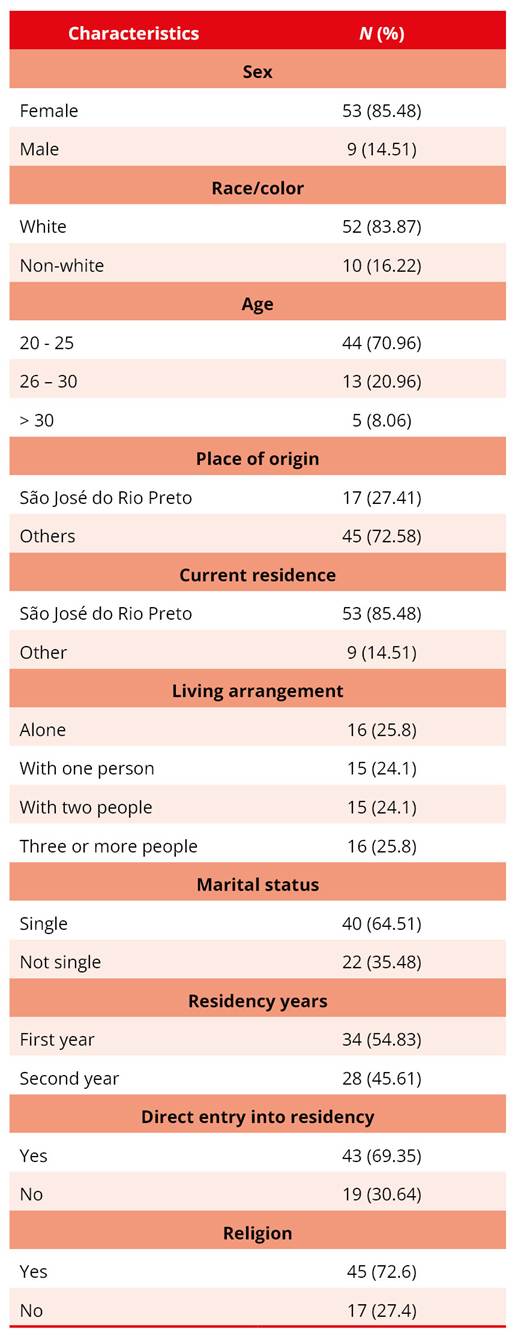
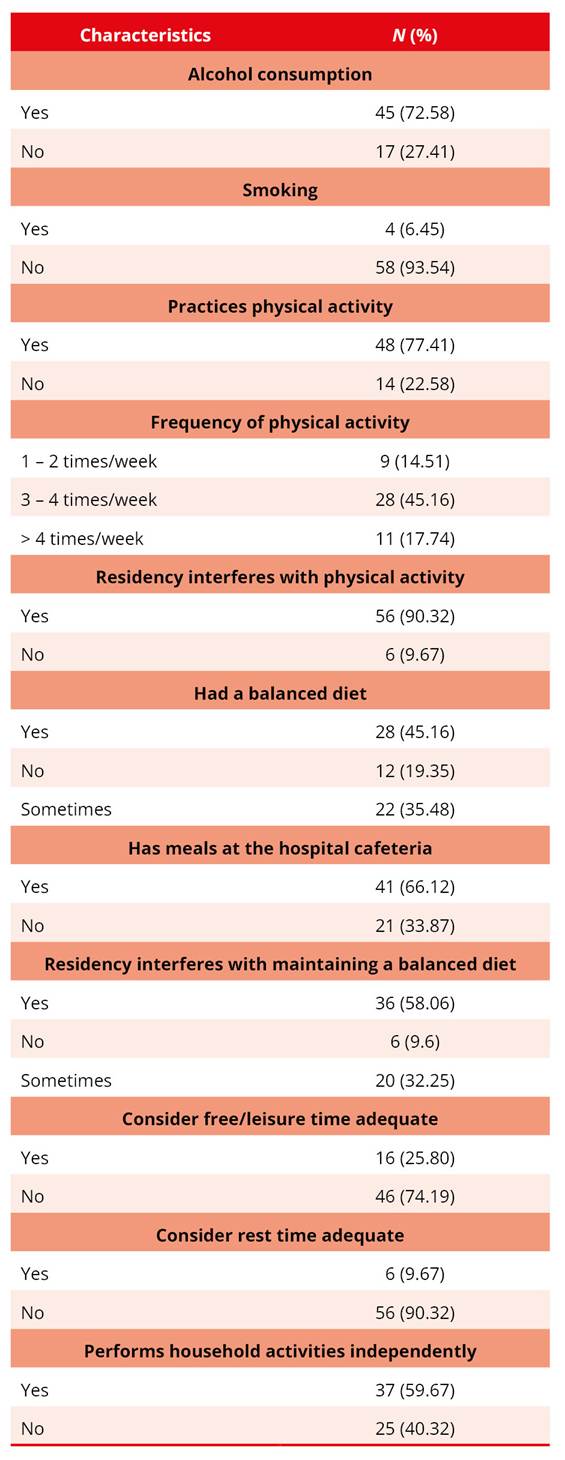
Table 2 presents data regarding lifestyle habits. Among the 62 study participants, 45 (72.58%) reported consuming alcoholic beverages. Among these, 31 (68.88%) stated that they consumed alcohol only on certain occasions, while 12 (28.88%) consumed alcohol one to two times per week, and only one resident (2%) reported consuming alcohol more than twice per week. Regarding the onset of alcohol consumption, 42 participants (93%) stated that they already had this habit before residency, while three (7%) reported beginning alcohol consumption after entering residency.
Regarding smoking, 58 participants (93.5%) reported they did not smoke. Concerning diet, 28 residents (62.2%) reported having a balanced diet. Two residents (3%) ate one to two meals per day, 47 (75.8%) had three to four meals per day, and 13 (20.9%) had five to six meals daily.
Regarding physical activity, 48 individuals (77.4%) reported engaging in physical exercise, while 14 (22.5%) did not. Among those who exercised, 9 (14.51%) reported exercising one to two times per week, 28 (45.1%) exercised three to four times per week, and 11 individuals (17.7%) exercised more than four times per week. Among the 62 residents, 56 (90.3%) reported that residency interfered with the practice and frequency of physical activity, whereas 6 (9.6%) reported no interference.
Regarding diet, 28 residents (45.1%) adopted a balanced diet, while 12 (19.3%) reported they did not follow this type of diet, and the remaining 22 residents (35.4%) stated that they sometimes followed a balanced diet. Since the institution offered meals daily, 41 individuals (66.1%) used the hospital cafeteria, while 21 (33.8%) did not. Additionally, 36 residents (58%) indicated that residency interfered with maintaining a balanced diet, 6 (9.6%) reported no interference, and 20 individuals (32.2%) stated that there was occasional interference.
Regarding free time and leisure, 16 participants (25.8%) considered it sufficient, whereas 46 (74.1%) considered it inadequate. Similarly, regarding time dedicated to rest, 56 participants (90.3%) considered it inadequate, while only 6 (9.6%) considered it adequate. Finally, 37 individuals (59.6%) performed household activities on their own, while 25 (40.3%) did not.
Table 2. Lifestyle habits of study participants. São José do Rio Preto, 2025
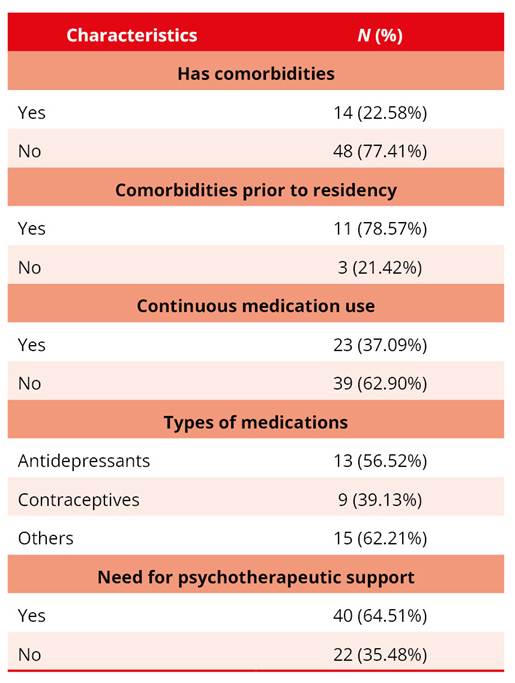
Clinical and psychological aspects are presented in Table 3, in which it can be observed that 14 participants (22.58%) reported having one or more comorbidities. Most participants did not use continuous medication — 39 (62.90%); however, there was a predominance of participants reporting the need for psychotherapeutic support — 40 (64.51%). It is noteworthy that 13 individuals (56.52%) among those using continuous medication reported antidepressant use.
Table 3. Clinical and psychological aspects of study participants. São José do Rio Preto, 2025
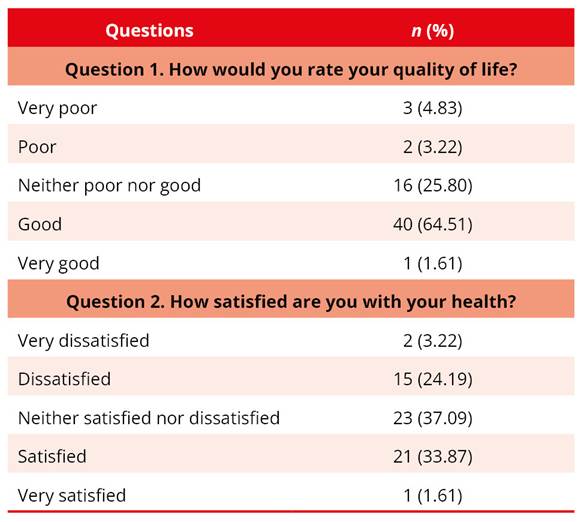
Regarding the analysis of questions 1 (self-reported quality of life) and 2 (satisfaction with one’s own health) of the WHOQOL-bref, the highest frequency was observed among residents who considered their quality of life “good” — 40 (64.51%) — and who reported being neither satisfied nor dissatisfied with their health — 23 (37.09%) (Table 4).
Table 4. Descriptive analysis of questions 1 and 2 of the WHOQOL-bref questionnaire. São José do Rio Preto, 2025
Analysis of Cronbach’s Alpha showed that, considering all four domains together, an Alpha = 0.74 was obtained, indicating good reliability of the questionnaire as a whole. However, each individual domain showed moderate reliability. The scores calculated for each domain presented similar values, with the highest score observed in the social relationships’ domain (69.89) and the lowest in the psychological domain (64.9).
Table 5. Mean score and Cronbach’s Alpha of WHOQOL-bref domains. São José do Rio Preto, 2025

4. Discussion
The study sample consisted predominantly of female professionals aged between 20 and 25 years, single, originally from other cities but currently living in São José do Rio Preto, where the institution in which the study was conducted is located. This sociodemographic profile is supported by recent findings regarding multiprofessional residency13.
Regarding the WHOQOL-bref questionnaire, moderate reliability was observed, since Cronbach’s Alpha demonstrated moderate values across all domains. These findings may be related to the heterogeneity of the sample, which included several professions, age groups, and different residency programs, in addition to involving complex variables such as financial conditions, housing environment, transportation, among others. In this context, Cronbach’s Alpha values tend to decrease, as demonstrated in a similar cross-sectional study14 and in specific analyses of this index15. Nevertheless, the questionnaire’s overall alpha value was highly satisfactory (0.74), reinforcing the overall reliability of the instrument.
Quality of life scores in each domain reached moderate levels, with the lowest score found in the psychological domain. This finding is associated with the substantial need for psychotherapeutic support, antidepressant use, and lack of leisure and rest, data identified in the sociodemographic profile and directly impacting work activities. Approximately 90% of participants considered their rest time inadequate, which may have significant effects on both physical and mental health during residency. It is important to highlight that this domain is strongly influenced by others, especially regarding sleep quality, favorable environment, and healthy social relationships.
Furthermore, the impact of the COVID-19 pandemic on many of these cases must be considered, since several studies have demonstrated significant mental health damage among healthcare professionals caused by this global event, with repercussions that persist to the present day16. These aspects are corroborated by the mean score of the physical domain, particularly concerning fatigue, tiredness, and excessive workload, considering the alarming findings of a study on sleep quality among multiprofessional residents, in which approximately 90% of the sample reported sleep difficulties17.
Regarding the social relationships’ domain, a score of 69.89 was obtained, representing the highest score among all domains, although still below expected standards. This finding may be associated with the significant pressure experienced by healthcare professionals when dealing with the well-being of other individuals, which may lead to interpersonal distancing and social isolation, as previously described in the literature4.
The environment-related domain presented a score of 67.37, which is probably associated with precarious conditions related to transportation and urban mobility, leisure spaces, and financial conditions. This finding is supported by the literature, especially in studies conducted in metropolitan and large urban centers such as Porto Alegre18, reinforcing the global biopsychosocial aspects affecting residents.
Finally, the physical domain also remained below expected levels, despite most participants practicing physical activity regularly. This decline may be associated with poor sleep quality and lower physical disposition, characteristics that are strongly interconnected, in addition to the lack of a balanced diet according to most responses. A previous study demonstrated that sleep quality tends to worsen after entering residency, considering the extensive workload and increased responsibilities19.
The two questions regarding overall quality of life largely reflect the findings observed in each domain, with approximately 66% of participants classifying their quality of life as at least good, and around 35% reporting satisfaction in this regard. This result highlights the central issue of the present study, serving as a warning to residency committees, faculty members, preceptors, and residents from various residency programs, enabling possible changes based on observations regarding quality of life so that these professionals may perform their duties with better health and performance19.
Based on the findings, the creation of easily accessible psychiatric and psychotherapeutic support programs in safe environments where residents can seek help during moments of crisis is considered necessary. It is essential that residency programs provide spaces for discussions about mental health, since residents spend most of their days within the institution and need to have their psychological complaints welcomed without judgment. In parallel, the establishment of free time schedules, adequate timetables to reconcile workload and other necessary activities, as well as appropriate spaces and time for rest, may positively impact residents’ lives and health.
Within this context, in order to improve residents’ work environment and consequently their quality of life, the training of preceptors is extremely important20. As already described in the literature, in most cases preceptors do not receive prior preparation and, at times, the healthcare institution responsible for the residency program is also not adequately structured and organized for this activity21. Continuing the discussion regarding preceptor training, it would also be extremely important for residents to have spaces for feedback, whether positive or negative, allowing programs to receive constructive criticism and improve collaboratively.
This study has limitations, especially regarding sample size, which was smaller than expected, since not all multiprofessional residents completed the informed consent form and subsequently the data collection instrument. Another important limitation is that this was a single-center study, which may create bias when generalizing the findings to other populations.
5. Final considerations
The present study contributes to advances in identifying structural and specific demands within multiprofessional health residency programs, since it analyzes residents’ quality of life from their own perspectives. The psychological domain proved to be the most affected, reinforcing the need for mental health to become a priority topic in order to establish improvement strategies. This context may be mainly associated with the emotional demands characteristic of healthcare work combined with the extensive workload of residency programs, with insufficient leisure and rest periods, which also negatively impacts the physical domain. On the other hand, the social domain obtained the highest score, which may indicate that, despite remaining below average, there is still a significant support network among multiprofessional residents.
In order to obtain the most reliable results possible, it is essential that each center conducts its own assessment of its resident population to avoid generalization bias, since each program has different needs and demographic profiles. The findings discussed here emphasize the need for a critical structural analysis of multiprofessional residency programs, including the development of actions that directly address issues such as leisure and rest time, psychological status, and residents’ social relationships
Authors’ contributions
The authors declared having made substantial contributions to the work regarding the conception or design of the research; acquisition, analysis, or interpretation of data; and writing or critical revision of relevant intellectual content. All authors approved the final version to be published and agreed to assume public responsibility for all aspects of the study
Competing interests
No financial, legal, or political conflicts involving third parties (government, companies, private foundations, etc.) were declared for any aspect of the submitted work, including but not limited to grants, funding, advisory board participation, study design, manuscript preparation, statistical analysis, among others.
Indexers
The Journal of Contemporary Nursing is indexed by DOAJ and EBSCO.
References
1. Ruidiaz-Gómez KS, Cacante-Caballero JV. Historical development of the concept Quality of life: literature review. Rev cienc cuidad. 2021;18(3):86–99. https://doi.org/10.22463/17949831.2539
2. The WHOQOL Group. Development of the World Health Organization WHOQOL-BREF quality of life assessment. Psychol Med. 1998;28(3):551-8. https://doi.org/10.1017/S0033291798006667
3. Camargo SF, Almino RHSC, Diógenes MP, Oliveira Neto JP, Silva IDS, Medeiros LC, et al. Quality of working life from the perspective of different groups of professionals working in a maternity hospital. Ciênc Saúde Coletiva. 2021;26(4):1467–76. https://doi.org/10.1590/1413-81232021264.02122019
4. Lorena LT, Nicolussi AC, Camargo FC, Lemos RCA, Souza LS, Rezende MP. Quality of life of residents in the multidisciplinary residency program at a teaching hospital. Rev Fam, Ciclos Vida Saúde Contexto Soc. 2023;11(4):e6786. https://doi.org/10.18554/refacs.v11i4.6786
5. Silva LB. Multi-professional Residency in Health in Brazil: Some aspects of the historic trajectory. Rev Katálysis. 2018;21(1):200–9. https://doi.org/10.1590/1982-02592018v21n1p200
6. Nakamura L, Aoyagi GA, Dorneles SF, Barbosa SRM. Correlation between productivity, depression, anxiety, stress and quality of life in multiprofessional health residents. Braz J of Develop. 2020;6(12):96892–905. https://doi.org/10.34117/bjdv6n12-254
7. Oliveira ALGB, Lima ICN, Barros MD, Costa TKS, Rique J, Silva FMV. Impressions about work, health and quality of life from the viewpoint of Brazilian multiprofessional residents. Enferm Bras. 2023;22(1):118-31. https://doi.org/10.33233/eb.v22i1.5080
8. Miranda JC, Fadel CB, Lima ML, Bordin D. Qualidade de vida entre residentes e trabalhadores de um hospital universitário: estudo comparativo. Revista Stricto Sensu. 2022;7(1). https://doi.org/10.24222/2525-3395.2022v7n1p029
9. Dal Pai D, Olino L, Eich L, Lautenchleger R, Fernandes MNS, Tavares JP. Factors associated with the quality of life of multi-professional health residents. Rev Bras Enferm. 2022;75(6):e20210541. https://doi.org/10.1590/0034-7167-2021-0541
10. Fleck MPA. The World Health Organization instrument to evaluate quality of life (WHOQOL-100): characteristics and perspectives. Ciênc Saúde Coletiva. 2000;5(1):33–8. https://doi.org/10.1590/S1413-81232000000100004
11. Freitas ALP, Rodrigues SG. A avaliação da confiabilidade de questionários: uma análise utilizando o coeficiente alfa de Cronbach. In: Simpósio de Engenharia de Produção (XII SIMPEP). Bauru: Unesp; 2005. https://doi.org/10.13140/2.1.3075.6808
12. Delighted [Internet]. Sample size calculator: find your sample size. Available from: https://delighted.com/sample-size-calculator
13. Fernandes MNS, Beck CLC, Weiller TH, Coelho APF, Vasconcelos RO, Dal Pai D. Sociodemographic characterization and motivations of multiprofessional residents in health. REAS/EJCH. 2020;12(11):e4405. https://doi.org/10.25248/reas.e4405.2020
14. Zanei SSV, Oliveira RA, Whitaker IY. Quality of life of health professionals of multidisciplinary residency programs. Rev Enferm UFSM. 2019;9(e35):1-20. https://doi.org/10.5902/2179769230013
15. Sharma B. A focus on reliability in developmental research through Cronbach’s Alpha among medical, dental and paramedical professionals. Asian Pac J Health Sci. 2016;3(4):271–8. https://doi.org/10.21276/apjhs.2016.3.4.43
16. Chew NWS, Lee GKH, Tan BYQ, Jing M, Goh Y, Ngiam NJH, et al. A multinational, multicentre study on the psychological outcomes and associated physical symptoms amongst healthcare workers during COVID-19 outbreak. Brain Behav Immun. 2020;88(1):559–65. https://doi.org/10.1016/j.bbi.2020.04.049
17. Moura FJL, Santos DNR, Barroso BIL. Work while they sleep? The quality of sleep of residents of Multiprofessional Health Residency Programs. Research, Society and Development. 2020;9(9):e44910910976. https://doi.org/10.33448/rsd-v10i9.10976
18. Parenza LN, Câmara SG. Person-City Relationships: Urban Mobility and Quality of Life in Porto Alegre (RS). Psicol cienc prof. 2022;42:e238317. https://doi.org/10.1590/1982-3703003238317
19. Moreira APF, Patrizzi LJ, Accioly MF, Shimano SGN, Walsh IAP. Quality of life evaluation, sleep and Burnout Syndrome the residentes of the multidisciplinary residency program in health. Medicina (Ribeirão Preto). 2016;49(5):393–402. DOI: https://doi.org/10.11606/issn.2176-7262.v49i5p393-402
20. Carlos AMM. Training actions aimed at developing skills for preceptorship in residency: the experience in a teaching hospital in southern Brazil. Saberes Plur. 2024;8(2):e141112. https://doi.org/10.54909/sp.v8i2.141112
21. Paula GB, Toassi RFC. Role and assignments of the preceptor in the training of health professionals in learning scenarios of the Unified Health System. Saberes Plur. 2021;5(2):125-42. https://doi.org/10.54909/sp.v5i2.117940
Appendix
Data collection instrument: WHOQOL abbreviated
1. How would you rate your quality of life?
1. Very poor
2. Poor
3. Neither poor nor good
4. Good
5. Very good
2. How satisfied are you with your health?
1. Very dissatisfied
2. Dissatisfied
3. Neither satisfied nor dissatisfied
4. Satisfied
5. Very satisfied
3. To what extent do you feel that (physical) pain prevents you from doing what you need to do?
1. Not at all
2. A little
3. A moderate amount
4. Very much
5. An extreme amount
4. How much do you need any medical treatment to function in your daily life?
1. Not at all
2. A little
3. A moderate amount
4. Very much
5. An extreme amount
5. How much do you enjoy life?
1. Not at all
2. A little
3. A moderate amount
4. Very much
5. An extreme amount
6. To what extent do you feel your life to be meaningful?
1. Not at all
2. A little
3. A moderate amount
4. Very much
5. An extreme amount
7. How well are you able to concentrate?
1. Not at all
2. A little
3. A moderate amount
4. Very much
5. An extreme amount
8. How safe do you feel in your daily life?
1. Not at all
2. A little
3. A moderate amount
4. Very much
5. An extreme amount
9. How healthy is your physical environment?
1. Not at all
2. A little
3. A moderate amount
4. Very much
5. An extreme amount
10. Do you have enough energy for everyday life?
1. Not at all
2. A little
3. A moderate amount
4. Very much
5. An extreme amount
11. Are you able to accept your bodily appearance?
1. Not at all
2. A little
3. A moderate amount
4. Very much
5. An extreme amount
12. Have you enough money to meet your needs?
1. Not at all
2. A little
3. A moderate amount
4. Very much
5. An extreme amount
13. How available to you is the information that you need in your day-to-day life?
1. Not at all
2. A little
3. A moderate amount
4. Very much
5. An extreme amount
14. To what extent do you have the opportunity for leisure activities?
1. Not at all
2. A little
3. A moderate amount
4. Very much
5. An extreme amount
15. How well are you able to get around?
1. Very poor
2. Poor
3. Neither poor nor good
4. Good
5. Very good
16. How satisfied are you with your sleep?
1. Very dissatisfied
2. Dissatisfied
3. Neither satisfied nor dissatisfied
4. Satisfied
5. Very satisfied
17. How satisfied are you with your ability to perform your daily living activities?
1. Very dissatisfied
2. Dissatisfied
3. Neither satisfied nor dissatisfied
4. Satisfied
5. Very satisfied
18. How satisfied are you with your capacity for work?
1. Very dissatisfied
2. Dissatisfied
3. Neither satisfied nor dissatisfied
4. Satisfied
5. Very satisfied
19. How satisfied are you with yourself?
1. Very dissatisfied
2. Dissatisfied
3. Neither satisfied nor dissatisfied
4. Satisfied
5. Very satisfied
20. How satisfied are you with your personal relationships?
1. Very dissatisfied
2. Dissatisfied
3. Neither satisfied nor dissatisfied
4. Satisfied
5. Very satisfied
21. How satisfied are you with your sex life?
1. Very dissatisfied
2. Dissatisfied
3. Neither satisfied nor dissatisfied
4. Satisfied
5. Very satisfied
22. How satisfied are you with the support you get from your friends?
1. Very dissatisfied
2. Dissatisfied
3. Neither satisfied nor dissatisfied
4. Satisfied
5. Very satisfied
23. How satisfied are you with the conditions of your living place?
1. Very dissatisfied
2. Dissatisfied
3. Neither satisfied nor dissatisfied
4. Satisfied
5. Very satisfied
24. How satisfied are you with your access to health services?
1. Very dissatisfied
2. Dissatisfied
3. Neither satisfied nor dissatisfied
4. Satisfied
5. Very satisfied
25. How satisfied are you with your transport?
1. Very dissatisfied
2. Dissatisfied
3. Neither satisfied nor dissatisfied
4. Satisfied
5. Very satisfied
26. How often do you have negative feelings such as blue mood, despair, anxiety, depression?
1. Never
2. Seldom
3. Quite often
4. Very often
5. Always
