Literature review
State liability for falls by the older adults in public spaces and institutions: scope review protocol / Responsabilidade do estado diante da queda de pessoas idosas em vias e em instituições públicas: protocolo de revisão de escopo
Simone Souza de Freitas1 (https://orcid.org/0000-0001-7719-8033)
Eliane Maria Ribeiro de Vasconcelos2 (https://orcid.org/0000-0003-3711-4194)
1Corresponding contact. Universidade Federal de Pernambuco (Recife). Pernambuco, Brazil. [email protected]
2Universidade Federal de Pernambuco (Recife). Pernambuco, Brazil.
ABSTRACT | OBJECTIVE: To map the scientific and legal evidence regarding the State liability arising from falls among older adults in public spaces and institutions. METHOD: This is a scoping review protocol registered with the Open Science Framework (OSF), conducted in accordance with the Joanna Briggs Institute methodology and the recommendations of the Preferred Reporting Items for Systematic Reviews and Meta-Analyses - Scoping Review (PRISMA-ScR). The search strategy will be applied to the Medline/PubMed, Scopus, Web of Science, CINAHL, and LILACS databases. Gray literature sources will also be consulted, such as the Brazilian Digital Library of Theses and Dissertations (BDTD), ProQuest Dissertations and Theses, and Google Scholar. Study selection will be conducted in pairs, independently, using the Rayyan platform. Data will be presented in tables, accompanied by a narrative summary. RESULTS: This study will enable mapping of evidence on the State liability for falls among older adults in public spaces, including epidemiological, legal, and regulatory aspects. CONCLUSION: This study may strengthen the evidence on this topic and inform public policies and nursing practice focused on the safety of older adults.
KEYWORDS: Aged. Accidental Falls. Built Environment. Civil Liability. Jurisprudence.
RESUMO | OBJETIVO: Mapear evidências científicas e jurídicas sobre as responsabilidades do Estado decorrentes de quedas de pessoas idosas em vias e em instituições públicas. MÉTODO: Trata-se de um protocolo de revisão de escopo com registro na Open Science Framework (OSF), conduzido conforme a metodologia do Joanna Briggs Institute e as recomendações do Preferred Reporting Items for Systematic Reviews and Meta-Analyses - Scoping Review (PRISMA-ScR). A estratégia de busca será aplicada nas bases de dados Medline/PubMed, Scopus, Web of Science, CINAHL e LILACS. Também serão consultadas fontes de literatura cinzenta, como a Biblioteca Digital Brasileira de Teses e Dissertações (BDTD), a ProQuest Dissertations and Theses e Google Scholar. A seleção dos estudos ocorrerá em pares, de forma independente, por meio da plataforma Rayyan. A apresentação dos dados será por meio de tabelas, acompanhados de uma síntese narrativa. RESULTADOS: Os resultados deste estudo possibilitarão o mapeamento das evidências sobre a responsabilidade do Estado diante das quedas de pessoas idosas em espaços públicos, incluindo aspectos epidemiológicos, legais e normativos. CONCLUSÃO: Este estudo poderá contribuir para o fortalecimento das evidências sobre a temática e subsidiar políticas públicas e a prática da enfermagem voltadas à segurança da pessoa idosa.
PALAVRAS-CHAVE: Idoso. Acidentes por Quedas. Ambiente Construído. Responsabilidade Civil. Jurisprudência.
How to cite this article: Freitas SS, Vasconcelos EMR. State liability for falls by the older adults in public spaces and institutions: scope review protocol. J Contemp Nurs. 2026;15:e6823. https://doi.org/10.17267/2317-3378rec.2026.e6823
Submitted Mar. 5, 2026, Accepted May 22, 2026, Published July 13, 2026
J. Contemp. Nurs., Salvador, 2026;15:e6823
https://doi.org/10.17267/2317-3378rec.2026.e6823
ISSN: 2317-3378
Assigned editors: Cátia Palmeira, Tássia Macêdo
1. Introduction
Population aging is one of the most significant demographic shifts of the 21st century. According to the World Health Organization (WHO), it is estimated that by 2050 there will be 2.1 billion people aged 60 or older worldwide, and that nearly 80% of this population will live in low- and middle-income countries1. This phenomenon is linked to rising life expectancy and falling fertility rates, which pose significant challenges to health care systems and public policy1.
Among the health issues affecting the older adult population, falls are one of the most common and debilitating events, accounting for a large proportion of hospitalizations and incurring high costs for the healthcare system. According to the WHO, falls are among the leading causes of death from unintentional injuries in people aged 65 and older, with an estimated 37.3 million falls worldwide each year2. Such incidents not only result in direct physical consequences, such as hip fractures, head injuries, and loss of function, but also have psychological effects, such as a fear of falling again and social isolation3.
In Brazil, falls among older adults also constitute a significant public health problem. The National Health Survey (PNS 2019) indicated that approximately 27.6% of older adults reported at least one fall in the past 12 months, with even higher percentages when factors such as the use of multiple medications and adverse environmental conditions are taken into account4. The same study found that extrinsic structural factors, such as uneven sidewalks, a lack of adequate signage, and obstacles on public roads, contribute to falls, thereby increasing the liability of public authorities for environmental safety4.
Although the data indicate a growing trend, the Brazilian scientific literature still has significant gaps regarding a comprehensive understanding of state responsibility for falls among older adults in public settings and long-term care facilities. While clinical and epidemiological studies explore risk factors and strategies for preventing falls in home and institutional settings, there is a lack of analyses that link such evidence to the legal framework and the obligations of the Brazilian government. These frameworks include the normative literature comprising laws, decrees, public policies, and regulations that establish rights and duties related to the protection of older adults as well as the jurisprudential literature, consisting of the body of judicial decisions that interpret and apply these norms in specific cases, particularly regarding the State’s strict liability for omissions and failures to ensure safe public environments5.
From a legal standpoint, the Older Persons Statute (Law No. 10,741/2003) establishes the State’s duty to ensure the protection of the life, health, and dignity of older adults through public policies. This duty is linked to the State’s strict civil liability, as provided for in Article 37, Paragraph 6 of the 1988 Federal Constitution, based on the theory of administrative risk6. It is important to note that this legal framework was updated by Law No. 14,423, dated July 22, 2022, which amended the Older Persons Statute to reinforce provisions related to the protection and guarantee of the rights of older adults, thereby strengthening the regulatory framework for their protection and paving the way for greater institutional accountability7. However, the implementation of these guidelines in terms of environmental fall prevention and accountability in cases of institutional negligence still lacks systematic analysis and critical evaluation in the national literature.
Thus, there is a clear need to integrate epidemiological, legal, and public policy knowledge in order to gain a comprehensive understanding of how and to what extent the Brazilian government responds to falls among older adults in public spaces and institutions. Such an approach is essential to enhance nursing practice in health care for older adults, particularly in identifying risks, implementing fall prevention measures, and providing safe and comprehensive care, as well as to support the identification of regulatory gaps and the formulation of recommendations that strengthen the protection of this population’s rights in the context of rapid demographic aging.
In this regard, the objective of this study is to review scientific and legal evidence regarding the State liabilities arising from falls involving older adults in public spaces and institutions, thereby contributing to a deeper legal and public health debate and to the improvement of public policies aimed at ensuring the safety and protection of the older adult population.
2. Method
This is a scoping review protocol developed in accordance with the guidelines proposed by the Joanna Briggs Institute (JBI) for Scoping Reviews8. Its findings will use the checklist Preferred Reporting Items for Systematic Reviews and Meta-Analyses extension for Scoping Reviews (PRISMA-ScR)9. The protocol was registered with the Open Science Framework (https://doi.org/10.17605/OSF.IO/46ACR).
2.1 Research question
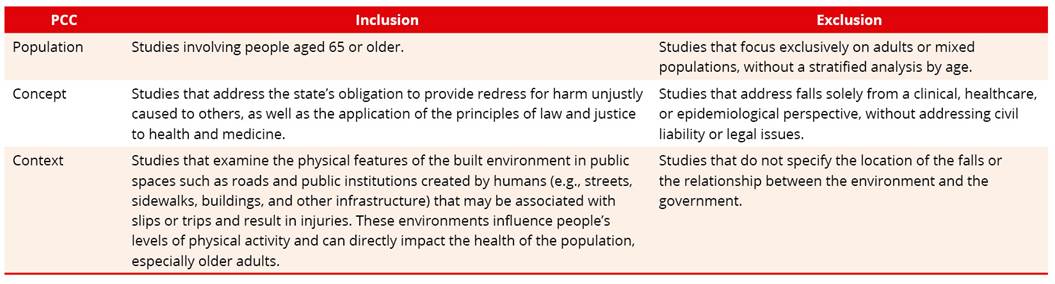
To formulate the central research question of this study, the mnemonic PCC was used, which stands for: Population (Older adults), Concept (Civil Liability and Case Law), and Context (Built Environment and Falls). Based on these components, the following research question was formulated: “What does the normative, jurisprudential, and scientific literature reveal about the State liability in cases of falls involving older adults on public roads and in public institutions?”
2.2 Eligibility criteria
Table 1 outlines the inclusion and exclusion criteria established based on the PCC (Population, Concept, Context) strategy, which guide the selection of studies to be considered in the scoping review.
Table 1. Study eligibility criteria, according to the PCC strategy used. Recife, PE, Brazil, 2025
2.3 Types of evidence sources
Studies employing any methodological design will be considered, provided they address the research question. The following databases will be used: National Library of Medicine and National Institutes of Health (Medline/PubMed), Scopus, Web of Science, Cumulative Index to Nursing and Allied Health Literature (CINAHL-EBSCO), and Latin American and Caribbean Health Sciences Literature (LILACS). The databases will be accessed through the Journal Portal of the Coordination for the Improvement of Higher Education Personnel (CAPES), via the Federated Academic Community (Comunidade Acadêmica Federada - CAFe) provided by the Federal University of Pernambuco (Universidade Federal de Pernambuco - UFPE). Additional searches will include: the Brazilian Digital Library of Theses and Dissertations (BDTD), ProQuest Dissertations and Theses, Google Scholar, and a review of the references from the primary studies.
The inclusion of these sources stems from the interdisciplinary nature of the subject matter, which encompasses indexed scientific literature and government documents, legislation, guidelines, dissertations, theses, and judicial decisions that may be relevant to the analysis of the topic. The terms used, the search criteria applied, the dates of the searches, and the number of documents retrieved and selected will be recorded, ensuring traceability, transparency, and methodological reproducibility.
2.4 Search strategy
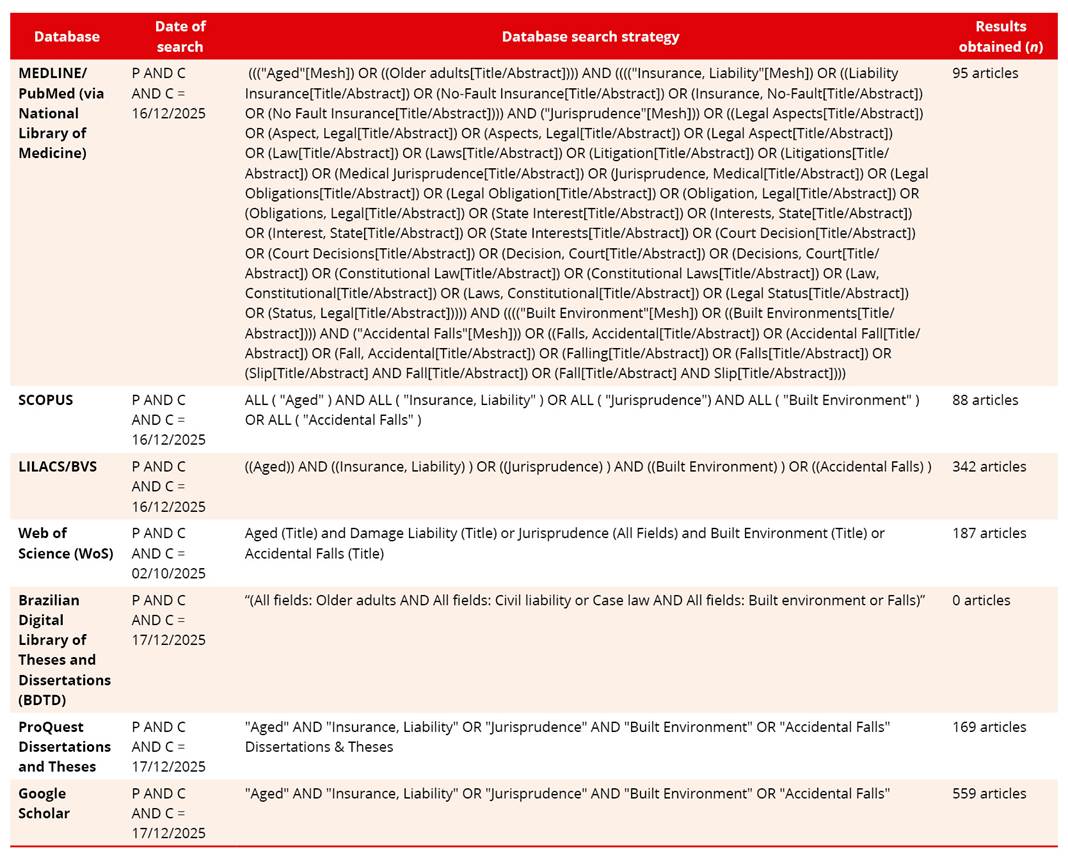
The search strategy was developed based on a combination of controlled vocabulary terms, as recorded in the following platforms: Health Sciences Descriptors (Descritores em Ciências da Saúde - DeCS) and Medical Subject Headings (MeSH), including their respective synonyms. These terms were combined using the Boolean operators AND and OR and adapted to the specific characteristics of each database consulted (Table 2). The review will include studies in any language, as well as sources of gray literature, and there will be no time limit.
Table 2. Database search strategies and number of results obtained. Recife, PE, Brazil, 2025
2.5 Selection of studies
At this stage, masking or truncation operators, as well as database filters, will not be applied. Once the search is complete, the retrieved files will be imported into EndNote software (Clarivate Analytics, USA)9, online version, to identify and remove duplicate bibliographic references obtained from different data sources.
They will then be transferred to the Rayyan software (Qatar Computing Research Institute, Doha, Qatar), which will assist with blinding the reviewers, identifying any remaining duplicates, and analyzing, selecting, and excluding articles.
First, studies will be preselected by reviewing their titles and abstracts to assess their alignment with the established eligibility criteria and the research question. The preselected articles will be read in full and their references will be evaluated, with the aim of including new studies not identified in the initial search. This evaluation will be conducted by two independent reviewers; if there is disagreement among the reviewers regarding the selection of references, a third reviewer will be consulted.
Studies from the gray literature will follow the same standardized procedures as those for peer-reviewed published content. The search results and inclusion process will be explained at the end of the scoping review and presented using a flowchart adapted from the Preferred Reporting Items for Systematic Reviews and Meta-analyses (PRISMA) guidelines.
2.6 Data extraction
Data collection for the selected studies will be conducted using a tool adapted from the model suggested in the JBI manual. The instrument for descriptive mapping of the study variables will be created in Microsoft Office Excel, in a tabular format, initially including the following variables: Title, year, country, authors, authors’ professional category, study design, objectives, level of evidence, results, and conclusion (Table 3). The table will be completed by the two principal reviewers, independently, in accordance with the objectives and the research question of the review.
Table 3. Data extraction from the selected studies. Recife, PE, Brazil, 2025
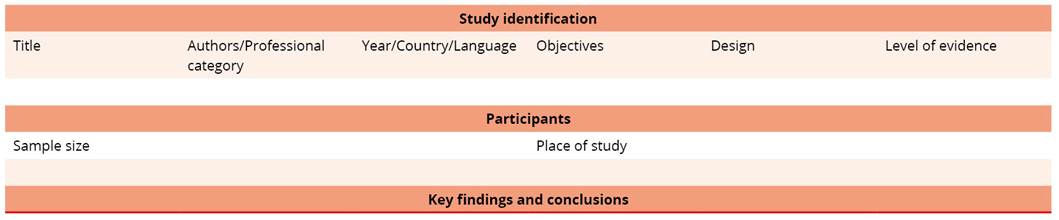
The form may be revised and adjusted if it becomes necessary to include additional information not initially covered, as shown in Table 3. Any changes will be made after the scoping review.
2.7 Data analysis and presentation
The results will be presented in a descriptive manner to address the research questions of this review, and the studies selected for the systematic review will be presented in figures in accordance with the Preferred Reporting Items for Systematic Reviews and Meta-Analyses (PRISMA), along with a narrative summary of the findings.
3. Expected results
The results of this scoping review will be presented in a descriptive and narrative manner, in accordance with the JBI recommendations for this type of study design. The process of identifying, screening, and including studies will be presented using a flowchart developed according to the PRISMA-ScR guidelines, detailing the sources consulted, the records identified, those excluded (with respective justifications), and the studies included in the final synthesis. The evidence included in this review will be organized in a data extraction table, and the narrative synthesis will integrate the mapped data, grouping them according to the research questions of this review.
In addition, the review is expected to enable a comprehensive mapping of the available evidence regarding the epidemiological, legal, regulatory, and jurisprudential foundations that underpin the state’s responsibility for preventing falls among older adults in public spaces.
In addition, the study aims to identify gaps in scientific knowledge on the subject, provide insights to strengthen public policies for fall prevention, and contribute to nursing practice in the areas of health promotion, disease prevention, and the protection of the rights of older adults.
4. Conclusion
This protocol was developed to provide guidance on conducting a scoping review of the state liability regarding falls among older adults in public spaces, in accordance with the methodological recommendations of the JBI and the PRISMA-ScR guidelines, ensuring rigor, transparency, and reproducibility at every stage of the process.
By mapping and synthesizing scientific, regulatory, and jurisprudential evidence, this review has the potential to contribute to a multidimensional understanding of the issue, informing both the development of public policies on safety and urban accessibility and the rationale for nursing interventions aimed at promoting health and protecting the rights of older adults. The prior publication of this protocol reinforces our commitment to open science and to preventing duplication of effort in scientific research.
Acknowledgments
The authors would like to thank the public institutions and scientific databases that provided the information and legal documents used in the preparation of this study.
Authors’ contributions
The authors stated that they made substantial contributions to the work in terms of the conception or design of the research; the collection, analysis, or interpretation of data for the work; and the drafting or critical revision of the intellectual content. All authors approved the final version to be published and agreed to take public responsibility for all aspects of the study.
Competing interests
No financial, legal, or political conflicts involving third parties (government, private companies, private foundations, etc.) were reported regarding any aspect of the submitted work (including, but not limited to, grants and funding, membership on advisory boards, study design, manuscript preparation, statistical analysis, etc.).
Indexers
The Journal Contemporary Nursing is indexed in DOAJ and EBSCO.
References
1. World Health Organization. World report on ageing and health [Internet]. Geneva: WHO; 2015. Available from: https://www.who.int/publications/i/item/9789241565042/
2. Mao A, Su J, Ren M, Chen S, Zhang H. Risk prediction models for falls in hospitalized older patients: a systematic review and meta-analysis. BMC Geriatr. 2025;25:29. https://doi.org/10.1186/s12877-025-05688-0
3. Zhu RTL, Zuo JJ, Li KJ, Lam FMH, Wong AYL, Yang L, et al. Association of lower-limb strength with different fall histories or prospective falls in community-dwelling older people: a systematic review and meta-analysis. BMC Geriatr. 2025;25:83. https://doi.org/10.1186/s12877-025-05685-3
4. Peters MDJ, Marnie C, Tricco AC, Pollock D, Munn Z, Alexander L, et al. Updated methodological guidance for the conduct of scoping reviews. JBI Evid Synth. 2020;18(10):2119-26. https://doi.org/10.11124/JBIES-20-00167
5. Hu Z, Jiang S, Xin X, Niu X, Chen S, Gu J. Diagnostic accuracy of fall risk screening tools in older individuals: a systematic review with bivariate random-effects meta-analysis. J Am Med Dir Assoc. 2025;26(12):105943. https://doi.org/10.1016/j.jamda.2025.105943
6. Presidência da República (Brazil). Lei nº 10.741, de 1 out. 2003. Dispõe sobre o Estatuto da Pessoa Idosa e dá outras providências. [Internet]. Diário Oficial da União. Available from: https://www.planalto.gov.br/ccivil_03/leis/2003/l10.741.htm
7. Presidência da República (Brazil). Lei nº 14.423, de 22 jul. 2022. Altera a Lei nº 10.741, de 1º de outubro de 2003. [Internet]. Diário Oficial da União. Available from: https://www.planalto.gov.br/ccivil_03/_ato2019-2022/2022/lei/L14423.htm
8. Tricco AC, Lillie E, Zarin W, O'Brien KK, Colquhoun H, Levac D, et al. PRISMA extension for scoping reviews (PRISMA-ScR): checklist and explanation. Ann Intern Med. 2018;169(7):467-73. https://doi.org/10.7326/M18-0850
9. Mendes KDS, Silveira RCCP, Galvão CM. Use of the bibliographic reference manager in the selection of primary studies in integrative reviews. Texto Contexto Enferm. 2019;28:e20170204. https://doi.org/10.1590/1980-265X-TCE-2017-0204
